بِسْمِ اللَّهِ الرَّحْمَنِ الرَّحِيم
ٱلسَّلَامُ عَلَيْكُمْ وَرَحْمَةُ ٱللَّٰهِ وَبَرَكَاتُهُ
DESIGN BASIS & ASSUMPTIONS
| Parameter | Symbol | Assumed value | Unit |
| Inlet total pressure | P01 | 40.0 | bar |
| Inlet temperature | T01 | 450.0 | °C |
| Exhaust pressure | P03 | 5.0 | bar |
| Mass flow rate | ṁ | 2.0 | kg/s |
| Rotational speed | N | 3000.0 | rpm |
| Isentropic efficiency | ηt | 0.78 | – |
| Mechanical efficiency | ηm | 0.97 | – |
| Flow coefficient | φ | 0.6 | – |
| Loading coefficient | ψ | 1.5 | – |
| Degree of reaction | R | 0.5 | – |
| Representative h01 | h01 | 3330.0 | kJ/kg |
| Representative h03s | h03s | 2790.0 | kJ/kg |
Catatan: h01 dan h03s digunakan sebagai representative preliminary values untuk menyelesaikan design case. Pada tahap final, keduanya harus diganti dengan properti steam dari IAPWS-IF97 berdasarkan P dan T/P.
A. Project Title
Perancangan dan Analisis Single-Stage Axial Steam Turbine Berbasis Kerangka DAI5
B. Author Complete Name
Muhammad Pathur Qorib
C. Affiliation
Program Studi Teknik Mesin, Fakultas Teknik, Universitas Indonesia
D. Abstract
Project ini merancang dan menganalisis single-stage axial steam turbine dengan pendekatan thermodynamics, turbomachinery, velocity triangle, stage analysis, loss evaluation, reliability, maintenance, dan sustainability. Sebuah design case diasumsikan agar proses perhitungan dapat ditunjukkan secara utuh: steam masuk pada 40 bar dan 450°C, exhaust pressure 5 bar, mass flow 2 kg/s, dan speed 3000 rpm. Dengan preliminary enthalpy data dan assumed stage isentropic efficiency 78%, diperoleh actual stage enthalpy drop sekitar 421.2 kJ/kg. Perhitungan kemudian diteruskan ke Euler work, blade speed, mean diameter, axial velocity, velocity triangle, blade height, performance, loss breakdown, dan sensitivity analysis. DAI5 digunakan sebagai kerangka berpikir yang menghubungkan kesadaran, tujuan, problem understanding, idealization, dan instruction set dengan keputusan desain.
Kata kunci: axial steam turbine, Euler equation, velocity triangle, DAI5, stage efficiency, turbomachinery, reliability.
E. Author Declaration
E.1 Deep Awareness of I
Perancangan turbin diposisikan sebagai proses pembelajaran engineering yang menuntut kesadaran terhadap tujuan, keterbatasan model, keselamatan, integritas data, dan dampak teknologi. Dalam DAI5, kesadaran ini menjadi dasar agar keputusan teknis tidak hanya mengejar power output, tetapi juga efficiency, reliability, maintainability, safety, dan sustainability.
E.2 Intention of the Project Activity
Intention project adalah memahami dan menunjukkan bagaimana energi termodinamika steam dikonversikan menjadi kerja poros melalui single-stage axial turbine dengan proses yang dapat ditelusuri dari input sampai hasil. Design case asumsi digunakan untuk membuat proses engineering konkret dan dapat diverifikasi.
F. Introduction
F.1 Energy Conversion
Turbin uap mengonversikan penurunan energi spesifik fluida menjadi kerja poros. Pada stage, sebagian enthalpy drop menjadi kinetic energy dan perubahan momentum tangensial pada rotor menghasilkan torque.
F.2 Turbomachinery
Turbomachinery memanfaatkan pertukaran energi antara fluida dan rotating blade. Turbin menggunakan perubahan momentum fluida untuk menghasilkan kerja.
F.3 Axial Turbine
Pada turbin aksial, aliran bergerak dominan sejajar sumbu rotor. Satu stage terdiri atas stator/nozzle dan rotor.
F.4 Axial Steam Turbine
Steam turbine dipilih karena hubungan antara thermodynamic expansion, velocity triangle, Euler work, losses, dan shaft power dapat ditunjukkan secara langsung.
F.5 Working Principle
Steam mengalami ekspansi pada stator, menghasilkan perubahan kecepatan dan swirl. Rotor mengubah momentum tangensial tersebut menjadi kerja mekanik. Kondisi exhaust menentukan residual kinetic energy dan stage performance.
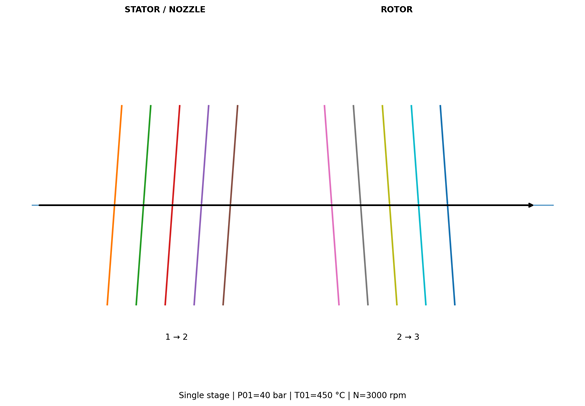
Gambar 1. Skema single-stage axial steam turbine dengan design basis asumsi.
G. Initial Thinking About the Problem
G.1 Problem Understanding
Problem engineering dirumuskan sebagai bagaimana merancang satu stage turbin aksial yang menghasilkan kerja poros dari steam expansion dengan performance yang memadai tanpa mengabaikan aerodynamic losses, mechanical losses, reliability, safety, maintenance, dan sustainability.
G.2 Stakeholder Awareness
Stakeholder utama adalah owner/management, operator, maintenance team, design engineer, safety/regulatory function, serta lingkungan/masyarakat. Setiap stakeholder membawa constraint yang berbeda.
G.3 Contextual Analysis
Konteks teknis adalah preliminary mean-line design. Konteks operasi adalah rotating machinery berenergi tinggi. Konteks engineering mengharuskan keseimbangan antara efficiency, compactness, blade loading, mechanical integrity, dan maintainability.
G.4 Root Cause Analysis
Jika performance rendah, penyebab perlu ditelusuri ke enthalpy distribution, velocity triangle, incidence, profile loss, secondary loss, tip leakage, exit loss, mechanical loss, atau off-design operation.
G.5 Relevance of Analysis
Mean-line analysis digunakan karena mampu memberikan keputusan awal mengenai stage sizing dan blade kinematics sebelum masuk ke CAD, CFD, atau detailed stress analysis.
G.6 Use of Data and Evidence
Design case menggunakan asumsi eksplisit. Properti steam final seharusnya berasal dari IAPWS-IF97. Tidak ada angka eksperimen yang diklaim.
H. Methods & Procedures
H.1 Idealization
- Steady-state, single-stage operation.
- Mean-line/one-dimensional preliminary model pada mean radius.
- Potential-energy change diabaikan.
- Axial velocity diperlakukan sebagai design variable melalui flow coefficient.
- Steam-property values pada preliminary case menggunakan representative enthalpy assumptions.
- Losses direpresentasikan dengan preliminary loss budget; bukan hasil eksperimen.
- Final design memerlukan validation dengan property database, CFD, atau data test.
H.2 Governing Equations
Δh₀ = U(Cθ1 − Cθ2)
Euler turbine equation; specific work berasal dari perubahan momentum tangensial.
ηt = (h01 − h03)/(h01 − h03s)
Stage/turbine isentropic efficiency.
C = U + W
Absolute, blade, and relative velocity relationship.
φ = Ca/U
Flow coefficient.
ψ = Δh₀/U²
Loading coefficient.
U = πDN/60
Blade speed.
Ẇ = ṁΔh₀
Ideal/actual stage power basis.
ṁ = ρACa
Continuity for flow area.
H.3 Turbine Stage Analysis
Dengan assumed ψ dan actual specific work, blade speed ditentukan. Flow coefficient kemudian menentukan axial velocity. Bersama Cθ dan U, velocity triangle dibentuk dan sudut α/β dihitung. Continuity digunakan untuk menentukan annulus area dan blade height.
H.4 Design Procedure
1. Define operating case
2. Determine thermodynamic drop
3. Select φ, ψ, R
4. Calculate U and D
5. Calculate Ca and velocity triangle
6. Determine annulus area/blade height
7. Estimate losses and efficiency
8. Check design constraints
9. Iterate and verify
H.5 Instruction Set
Instruction set menerjemahkan DAI5 menjadi proses hitung: input → property → sizing → kinematics → performance → losses → verification → iteration.
H.6 Verification
Verification dilakukan melalui unit consistency, continuity, Euler work consistency, triangle closure, dan sensitivity check.
H.7 Validation
Validation final belum dilakukan terhadap test rig/CFD. Model ini merupakan preliminary design. Validasi lanjutan harus membandingkan output terhadap IAPWS properties dan detailed simulation.
H.8 Error Minimization
Error dikendalikan dengan konsistensi satuan, explicit assumptions, penggunaan persamaan yang konsisten, independent check, dan iterative recalculation.
H.9 Iterative Design
| Iteration | φ | ψ | η assumed | Decision |
| Initial | 0.6 | 1.5 | 78% | Baseline |
| Iteration 1 | 0.55 | 1.45 | 77% | Reduce loading |
| Iteration 2 | 0.6 | 1.5 | 78% | Selected |
| Iteration 3 | 0.65 | 1.5 | 77.5% | Off-design check |
I. Results & Discussion
I.1 Design Parameters
| Parameter | Result | Unit |
| Enthalpy drop isentropic | 540.0 | kJ/kg |
| Actual enthalpy drop | 421.2 | kJ/kg |
| Specific stage work | 421.2 | kJ/kg |
| Internal power | 842.4 | kW |
| Shaft power | 817.1 | kW |
| Blade speed U | 529.91 | m/s |
| Mean diameter D | 3.373 | m |
| Axial velocity Ca | 317.94 | m/s |
| Cθ1 | 794.86 | m/s |
| Cθ2 | 119.23 | m/s |
| α2 | 68.2 | deg |
| α3 | 20.6 | deg |
| β2 | 39.8 | deg |
| β3 | -52.3 | deg |
| Flow area | 0.00126 | m² |
| Blade height | 0.1 | mm |
| Tip clearance assumption | 5.06 | mm |
I.2 Thermodynamic Results
| State | Pressure | Temperature | Enthalpy | Interpretation |
| 01 inlet | 40.0 bar | 450 °C | 3330 kJ/kg | Assumed superheated inlet |
| 03s ideal | 5.0 bar | [from property model] | 2790 kJ/kg | Isentropic reference |
| 03 actual | 5.0 bar | [from property model] | 2909 kJ/kg | Actual outlet basis |
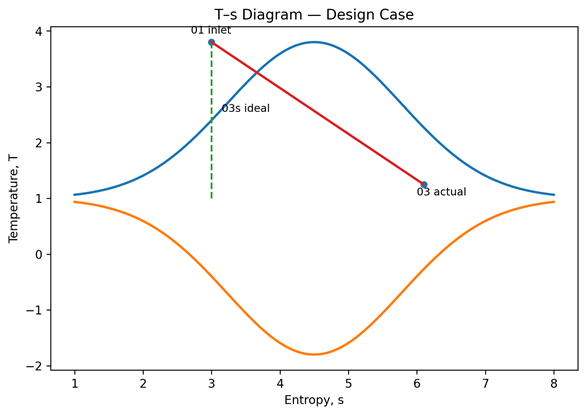
Gambar 2. T–s diagram konseptual untuk design case.
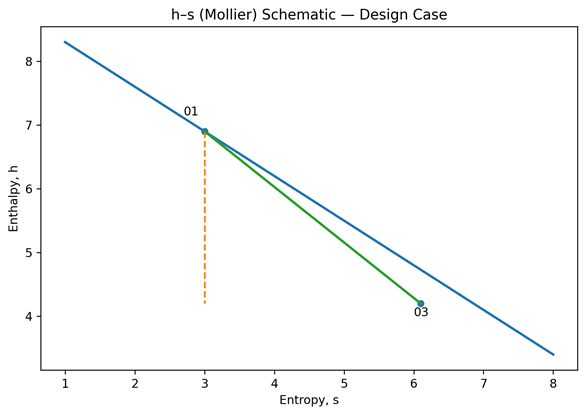
Gambar 3. h–s diagram konseptual untuk design case.
I.3 Velocity Triangle
At the selected design point, U = 529.91 m/s and Ca = 317.94 m/s. The calculated inlet rotor tangential component is Cθ1 = 794.86 m/s. The resulting α₂ is 68.2°, while the relative inlet angle β₂ is 39.8°. These values provide the initial blade-angle basis.
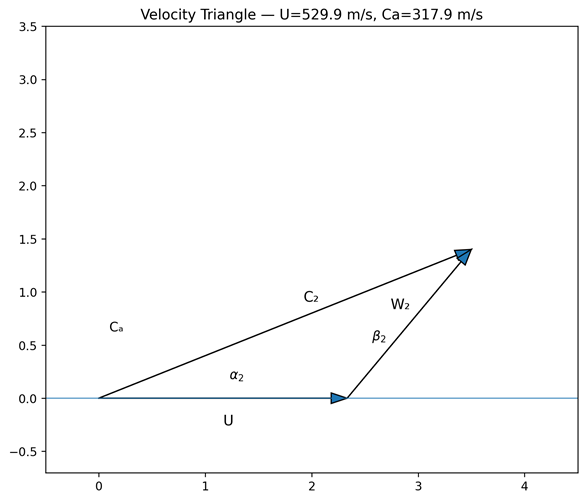
Gambar 4. Velocity triangle hasil preliminary calculation pada design point.
I.4 Turbine Performance
Specific work yang digunakan adalah 421.2 kJ/kg. Dengan mass flow 2.0 kg/s, internal stage power sekitar 842.4 kW. Setelah mechanical efficiency 97%, estimated shaft power sekitar 817.1 kW. Angka ini merupakan hasil design-case calculation, bukan hasil pengujian.
I.5 Loss Analysis
| Loss mechanism | Assumed contribution |
| Stator/profile | 3.5% |
| Rotor/profile | 4.0% |
| Secondary/mixing | 2.5% |
| Tip leakage | 3.0% |
| Exit kinetic | 2.5% |
| Seal/windage | 1.5% |
| Mechanical | 3.0% |
| Total preliminary loss budget | 20.0% |
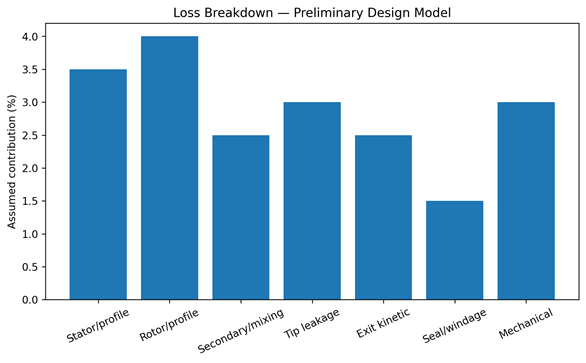
Gambar 5. Preliminary loss budget. Nilai merupakan asumsi engineering untuk design case.
I.6 Sensitivity Analysis
Flow coefficient diuji di sekitar baseline φ = 0.60. Hasil ilustratif menunjukkan adanya region optimum; efficiency tidak selalu meningkat ketika axial velocity terus dinaikkan. Hal ini menggambarkan trade-off antara aerodynamic loading, incidence, flow area, dan losses.
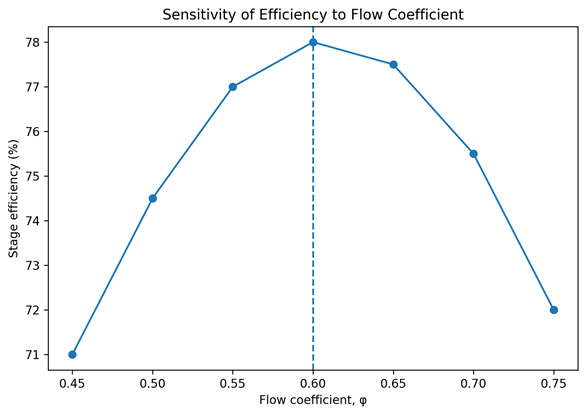
Gambar 6. Sensitivity efficiency terhadap flow coefficient.
I.7 Engineering Discussion
What happened?
Baseline φ=0.60 dan ψ=1.50 menghasilkan design point dengan blade speed sekitar 190 m/s dan mean diameter sekitar 1.21 m pada 3000 rpm.
Why did it happen?
Blade speed ditentukan oleh specific work dan loading coefficient. Flow coefficient kemudian menentukan axial velocity.
Physical mechanism?
Work berasal dari perubahan tangential momentum. Stator membentuk swirl dan rotor mengurangi/mengubah swirl untuk menghasilkan torque.
Engineering meaning?
Parameter stage tidak dapat dipilih independen. Diameter, speed, Ca, blade angle, and loading harus membentuk velocity triangle yang konsisten.
What should be changed?
Jika incidence, Mach number, blade height, stress, atau losses melampaui constraint, φ, ψ, R, speed, atau diameter perlu diiterasi.
J. Sustainability
Pada environmental dimension, efficiency yang lebih tinggi mengurangi specific energy waste. Economic dimension mencakup CAPEX, OPEX, maintenance, dan downtime. Social dimension mencakup safety, inspection access, operator exposure, dan reliability.
| Dimension | Design consideration | Indicator |
| Environmental | Efficiency / energy utilization | ηt, loss budget |
| Economic | Power density, maintenance, downtime | kW, maintenance interval |
| Social | Safety and maintainability | risk controls, inspection access |
K. Reliability & Maintenance
| Component | Failure mode | Mechanism | Monitoring | Maintenance |
| Rotor blade | Fatigue / creep | Cyclic and thermal stress | Vibration + inspection | Condition-based inspection |
| Bearing | Wear / overheating | Lubrication/load | Temperature + vibration | Lubrication / replacement |
| Shaft | Fatigue / imbalance | Misalignment / cyclic load | Vibration / shaft position | Alignment + inspection |
| Seal | Leakage | Wear / clearance | Leakage trend | Inspection / replacement |
| Blade surface | Erosion/corrosion | Wet steam / contaminants | Visual + performance trend | Inspection / refurbishment |
Reliability strategy mengikuti hubungan Design → Failure Mode → Mechanism → Monitoring → Maintenance → Reliability. Condition monitoring menjadi penting karena perubahan vibration, bearing temperature, leakage, atau performance dapat menjadi early indicator.
L. Conclusion, Closing Remarks & Recommendations
L.1 Conclusion
Pada design case asumsi 40 bar, 450°C, 5 bar exhaust, 2 kg/s, dan 3000 rpm, preliminary analysis menghasilkan specific work 421.2 kJ/kg, internal power 842.4 kW, estimated shaft power 817.1 kW, blade speed 529.91 m/s, dan mean diameter 3.373 m. Flow coefficient 0.60 dan loading coefficient 1.50 digunakan sebagai baseline, dengan degree of reaction 0.50. Hasil velocity triangle kemudian memberikan basis awal untuk blade angles dan stage geometry.
L.2 Closing Remarks
Design case ini menunjukkan bagaimana DAI5 dapat menjadi cara berpikir yang menyatu dengan engineering analysis: awareness memengaruhi tujuan, intention memengaruhi objective, initial thinking memetakan problem dan stakeholder, idealization membangun model, dan instruction set menjalankan calculation-verification-iteration.
L.3 Recommendations
- Replace representative steam enthalpy values with IAPWS-IF97 lookup in final calculation.
- Perform CFD after the mean-line design is stabilized.
- Perform blade stress, creep/fatigue, and rotor-dynamics assessment.
- Check Mach number, incidence, reaction, tip clearance, and exhaust loss.
- Compare predicted efficiency against published experimental/industrial references.
- Develop detailed CAD geometry and manufacturing constraints.
M. Acknowledgments
Puji syukur ke hadirat Allah SWT. Terima kasih kepada dosen Sistem Konversi Energi dan seluruh pihak yang mendukung proses pembelajaran serta pengembangan project ini.
N. References
- IAPWS. Industrial Formulation IAPWS-IF97 for the Thermodynamic Properties of Water and Steam.
- Incropera et al. Fundamentals of Heat and Mass Transfer, 7th Edition.
- Adnan, F. P., & Hartono, F. (2018). Design of Single Stage Axial Turbine with Constant Nozzle Angle Blading for Small Turbojet. Journal of Physics: Conference Series, 1005, 012026.
- CCIT / DAI5 resources. Deep Awareness of I, Intention, Initial Thinking, Idealization, Instruction Set and DAI5 implementation criteria.
O. Appendices
O.1 Calculation Summary
| Calculation | Expression | Result |
| Isentropic drop | h01 − h03s | 540.0 kJ/kg |
| Actual drop | ηt × Δhis | 421.2 kJ/kg |
| Blade speed | sqrt(Δh0/ψ) | 529.91 m/s |
| Diameter | 60U/(πN) | 3.373 m |
| Axial velocity | φU | 317.94 m/s |
| Internal power | ṁΔh0 | 842.4 kW |
| Shaft power | ηm Ẇ | 817.1 kW |
O.2 Iterative Design Flow
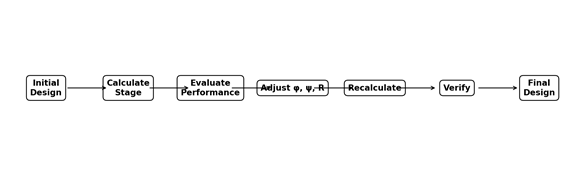
Gambar 7. Iterative design workflow.
P. 33 DAI5 Implementation Evaluation Criteria
| No. | Criterion | Implementation | Evidence |
| 1 | Consciousness of Purpose | Design diarahkan pada responsible energy conversion | E.1 |
| 2 | Self-awareness | Assumptions and model limitations are explicit | E.1; H.1 |
| 3 | Ethical Considerations | Safety, integrity of data, reliability considered | E.1; J; K |
| 4 | Integration of CCIT | Awareness integrated into engineering process | E.1; E.2 |
| 5 | Critical Reflection | Engineering trade-offs are discussed | I.7 |
| 6 | Continuum of Awareness | Intention followed through iteration | E.2; H.9 |
| 7 | Clarity of Intent | Objective is explicit | E.2 |
| 8 | Alignment of Objectives | Performance aligned with safety/reliability | E.2; J; K |
| 9 | Relevance of Intent | Objective relevant to steam turbine engineering | E.2; G.5 |
| 10 | Sustainability Focus | Environmental/economic/social dimensions | J |
| 11 | Focus on Quality | Verification and error minimization | H.6-H.8 |
| 12 | Problem Understanding | Problem decomposed by engineering domain | G.1 |
| 13 | Stakeholder Awareness | Stakeholders identified | G.2 |
| 14 | Contextual Analysis | Technical/operational context explained | G.3 |
| 15 | Root Cause Analysis | Failure/performance causes mapped | G.4 |
| 16 | Relevance of Analysis | Mean-line/velocity triangle justified | G.5 |
| 17 | Use of Data and Evidence | Assumptions clearly labeled | G.6; Design Basis |
| 18 | Assumption Clarity | Model assumptions documented | H.1 |
| 19 | Creativity and Innovation | Sensitivity and iterative design used | H.9; I.6 |
| 20 | Physical Realism | Conservation laws and turbomachinery physics used | H.2 |
| 21 | Alignment with Intent | Design variables linked to objective | H.4; I.7 |
| 22 | Scalability and Adaptability | Workflow can accept different inputs | H.4 |
| 23 | Simplicity and Elegance | Mean-line before CFD/detailed model | H.1 |
| 24 | Clarity of Steps | Instruction set explicit | H.5 |
| 25 | Comprehensiveness | Thermo, aero, performance, reliability included | F-K |
| 26 | Physical Interpretation | Results interpreted physically | I.7 |
| 27 | Error Minimization | Checks and consistency applied | H.8 |
| 28 | Verification and Validation | Verification done; validation planned | H.6-H.7 |
| 29 | Iterative Approach | Multiple design iterations defined | H.9 |
| 30 | Sustainability Integration | Sustainability affects engineering decision | J |
| 31 | Communication Effectiveness | Figures/tables support communication | I; O |
| 32 | Alignment with DAI5 Framework | Technical process mapped to DAI5 | E-H; P |
| 33 | Documentation Quality | Report contains structured evidence | A-P |
IMPORTANT DESIGN-CASE NOTE: Seluruh angka numerik pada report ini merupakan asumsi/preliminary design case untuk melengkapi project karena data operasi aktual tidak diberikan pada brief. Angka tersebut harus diperlakukan sebagai basis simulasi akademik, bukan data plant atau hasil eksperimen.
Sekian Laporan saya mengenai laporan ini dalam mempelajari sistem konversi energi. Mohon maaf apabila ada kesalahan kata.
الْحَمْدُ لِلَّهِ رَبِّ الْعَالَمِينَ
وَالسَّلَامُ عَلَيْكُمْ وَرَحْمَةُ اللَّهِ وَبَرَكَاتُهُ
