Author
Nayla Aamira Bachtiar (2306247206)
Affiliation
Departement of Mechanical Engineering, University of Indonesia
Abstract
This paper is made to predict the strength of the Vespa Sprint I-Get 150 ABS motorcycle stand, focusing on the integrity of its frame structure when given a load of Newton. This analysis is carried out by applying the Finite Element Analysis (FEA) Method. The FEA method was chosen because it can simulate complex load conditions and accurately predict its automotive structure. In making this paper, the author also uses the DAI 5 framework created by Prof. Dai as a lecturer from the Numerical Methods Class. The combination of FEA and DAI 5 is expected to be technically efficient and useful for the surrounding community. This project aims to evaluate the ability of the motorcycle stand to withstand passenger loads to ensure the safety and security of the rider, and to ensure its long service life. Proof of analysis can be done by conducting simulations through FEA software such as ANSYS which is used to analyze the stress distribution of motorcycle loads, motorcycle material fatigue, and deformation that will occur in the motor. After the simulation is carried out, areas with high concentrations will be seen in several components, especially in the drive and suspension systems.
Author’s Declaration
I realize that the analysis I did was by the will of Allah SWT as the creator of the universe. All physical phenomena that occur are by the will of Allah SWT and we as His people have the opportunity to study them. All analysis that we do must be in line with the main goal of knowing and acknowledging the creation of Allah SWT. This state is called the state of “nafs”. This awareness also makes me as a writer consider the long-term impact of the analysis carried out, namely to provide solutions that are beneficial to people around.
Project Activity Intentions
After aligning the goal with the will of Allah SWT, I set the intention of the heart that functions as heartware to ensure that all steps of problem solving are in line with the will of Allah SWT. My intention here is to analyze the strength of the Vespa Sprint I-Get 150 ABS motor with a rider load of 688 Newton using the FEA method and the DAI 5 framework. The focus of the analysis carried out is to find out areas that have high stress concentrations and design solutions to increase the durability of the motor for long-term use and the safety of the rider when riding the motorcycle. The intention to choose this topic came to my mind because I had seen a motorcycle stand that was bent due to excessive motorcycle load. This will certainly endanger the safety of passengers, therefore I have the intention to make design recommendations that can strengthen the motorcycle components so as to ensure that the motorcycle mcan function safely with static load conditions.
Preliminary
The motorcycle stand is one of the important components on a motorcycle that functions to support the motorcycle when it is stationary. On the Vespa Sprint I-Get 150 ABS motorcycle, the stand used are the side motorcycle stand and the front motorcycle stand. The side stand is on the lower left side of the motorcycle, while the center stand is usually used when the motorcycle is changing oil. The purpose of the study was to analyze the strength of the stand on the Vespa Sprint I-Get 150 ABS motorcycle using mild steel with a hole diameter of 1.6 cm and a ring diameter of 1.2 cm and a length of 20 cm. Corrosion and bending often occur on the motorcycle stand. Corrosion can cause a decrease in the quality of the mild steel causing the motorcycle stand to weaken quickly and break. In this stand simulation, there is a load of 70 kg or equivalent to 3041 N. This weight is the amount of the rider’s load. One of the methods that will be used is the application of the numerical method, namely finite element analysis (FEA). FEA is usually used as an analysis tool to obtain stress distribution and predict structural strength. This method is useful for checking the structural strength of the motorcycle stand and corrosion. By using analysis through the FEA method, it is expected to be the basis for improving the design and materials of the motorcycle stand. My main focus is to analyze the motorcycle load-bearing system. When the motorcycle is not operating but still has to withstand the load from the weight of the motorcycle, the rider, and other external loads. When the motorcycle is in a stopped condition, the main components of the motorcycle, namely the suspension load-bearing system, transmission joints, and other components will receive static loads that must be withstood without damaging the material.
The main problem that must be analyzed is how the Vespa Sprint I-Get 150 ABS motorcycle stand can withstand a static load of 3041 Newton when the motorcycle is stopped or parked. When the motorcycle is stopped, the load will be supported by various components and must be kept in balance. FEA is used to model and simulate how the motorcycle can withstand this load, in addition to analyzing whether the critical points on the motorcycle are able to withstand the load without experiencing material damage. Previous studies have focused more on analyzing dynamic loads, namely when the motorcycle is moving. However, they have paid less attention to the load received by the motorcycle when it is stationary. This study focuses on addressing the gap by analyzing the static load on the motorcycle received by the load-bearing system. The problem to be analyzed is how the stress distribution is in the load-bearing system. FEA can be used to calculate the stress and strain distribution received at these critical points and ensure that the load held by the motorcycle is safe. To analyze its strength, this problem is connected to several principles of physics such as material mechanics, stress and strain theory, and load distribution analysis. This principle is used as the basis for FEA.
Solution Methods and Steps
1. Idealization:
In the idealization stage, the FEA method is used to analyze the motor stand that receives the largest load. A load of 3041 Newton is applied to see how this component can withstand the load received. In the idealization stage, vulnerable points that require design improvements will be identified. Finite element analysis (FEA) is used to simulate when the motor holds the load. FEA divides the motorcycle stand into small elements which are then analyzed individually to determine their response to the load received. By applying the FEA method, the stress and strain distribution on the motorcycle stand can be analyzed in detail. FEA helps to calculate the load distribution and how the material responds to the force to minimize material failure. Advances in FEA applications such as ANSYS simulations allow for more detailed analysis of the motorcycle stand strength. ANSYS will produce von misses, displacement, and factor of safety values.
2. Instructions (Set):
In this analysis, a load of 3041 N is given. The load is obtained from the motorcycle load of 240 kg and the rider’s weight of 70 kg (3041 N). Then motorcycle stand strength analysis will be carried out involving ANSYS simulation to determine the stress, strain, and safety factor values. This step begins with forming the geometry of the motorcycle stand design using CAD software to describe the motorcycle stand components in detail and then imported into the FEA software for analysis. Then the next step is to carry out a static simulation analysis, input mild steel material, place the constraint position, input the load area, create a mesh that is finer the mesh results, the more accurate the results of the stress and strain calculations obtained, carry out simulations, and obtain the results of the stand simulation analysis which will determine whether it is in accordance with the safety factor value? If the safety factor value is not yet appropriate, a review of the materials used in the motorcycle stand must be carried out. In the FEA analysis, a stiffness matrix is used to calculate the stand response of the motorcycle to a load of 3041 N. Stress is calculated using the formula:


By using the stress and strain formula, FEA can calculate the stress and strain distribution on the motorcycle stand.
Calculation:
Given Data:
- Material: Mild Steel (Low Carbon Steel)
- Yield Strength: 250 Mpa
- Load (F): 3041 N
- Outer Diameter (D): 16 mm
- Inner Diameter (d): 12 mm
- Length (L): 200 mm
- Elastic Modulus: 210.000 N/mm2
- Safety Factor: Between 1,5-2,5
Cross Sectional Area

Stress Calculation (

Safety Factor Calculation (SF)

Momen of Inertia
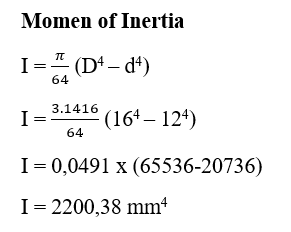
Displacement Calculation
Assume that it’s a cantilever beam

FEA Boundary Condition
- Fixed Consraint
I apply fixed support at one end of the motorcycle stand which restrics all degrees of freedom (X, Y, Z translation and rotation)
- Load Application
Apply axial force 3041 Newton along the longitudinal axis at the free end face
- Meshing Setup
The mesh type for this motorcycle stand is tetrahedral with 2-3 mm global size refine at critical areas
Results and Discussion
The results of the FEA simulation using ANSYS can show the results of the von misses (stress), displacement (strain), and safety factor calculations on the motorcycle stand. The axial stress generated by the 3041 Newton load is 34,56 MPa whiuch is far below the yield strength of mild steel (250 MPa). The safety factor is 7,23 which indicates the design is very safe under static axial loading conditions. The estimated displacement is 0,0175 mm confirms high stiffness. In ANSYS, the blue color on the von misses stress indicates that the von misses stress is small. The largest displacement is at the bottom of the stand which is indicated by the red color, the higher the color the bluer it is which indicates that the displacement is getting smaller. In the calculation of the safety factor, if it does not meet the safety standard, it will be red which means that the load being held is less safe and will potentially cause corrosion or bending if the load is not reduced. From these calculations, the results of stress, strain, and deformation can be seen. Therefore, it is necessary to optimize the motorcycle stand material to make it safer for riders.
Conclusion, Closing, Recommendations
Based on the results of the analysis using the FEA method and simulation using ANSYS, it can be concluded that simulation of dynamic loads is very necessary to analyze the motorcycle stand capability in withstanding loads.
Thank-you note
As the author, I would like to express my deepest gratitude to my family and closest friends who have always provided support in the preparation of this paper.
Cited References
J. A. Putra and M. N. Misbah, “Studi Pengaruh Ukuran Bracket Pondasi Mesin terhadap Tegangan dengan Menggunakan Finite Element Method,” J. Tek. ITS, vol. 11, no. 1, pp. G1–G6, 2022.
M. Z. M. Alie and M. I. Ramadhan, Perhitungan Kekuatan Kapal Dengan Metode Elemen Hingga. Deepublish, 2019.
Z. N. Alif, Analysis Kekuatan Standar Samping Motor Menggunakan Steel Carbon dengan Beban 1500 N Menggunakan Metode Finite Elemen Analysis, Jurnal Rekayasa Teknologi Nusa Putra, vol. 9, no. 2, pp. 102–107, 2023.
Attachments


The 33 DAI5 Implementation Evaluation Criteria
I. Deep Awareness of I
- Consciousness of Purpose
In this analysis, my main objective is to analyze the stand capability of the Vespa Sprint 150 I-Get ABS motorcycle in withstanding a static load of 3041 Newton. This study uses finite element analysis (FEA) to model the stress and strain distribution on the motorcycle stand. A deep awareness of the purpose of this analysis is essential to ensure that the motorcycle stand design has sufficient strength to withstand the load without damaging the material.
- Self awareness
As the author, I am self-aware that every result of FEA analysis and ANSYS simulation as well as the selection of motorcycle stand materials is very important to produce a safe design. Self-awareness leads to the author’s understanding that even though the data obtained is accurate, the design results still require validation from real-life conditions. This understanding encourages me to maintain integrity in the calculation process to produce factual data.
- Ethical Considerations
Ethical considerations are essential in this analysis because the design of the motorcycle stand must ensure the safety of its users. In the analysis process using the FEA method, I ensure that the motorcycle stand can withstand the load and does not damage the material.
- Integration of CCIT (Cara Cerdas Ingat Tuhan)
At every stage of the motorcycle stand analyst, I apply the awareness that the social responsibility that we have as students of the Department of Mechanical Engineering is not only to prioritize technical results, but also benefits for humanity and the surrounding environment. In this process I also always involve Allah SWT as the creator of the universe.
- Critical Reflection
In ANSYS simulation for motorcycle stand involves critical reflection on each simulation. If the ANSYS simulation results show red, I then reflect on how the stand design of this motorcycle should be improved to reduce the risk of material failure. Then are the assumptions applied to the model accurate? Critical reflection ensures that every decision in the stand design of the motorcycle must go through consideration of safety factors and material durability.
- Continuum of Awareness
This awareness is when I continuously try to improve the calculations and correct the analysis results every time the simulation is done. When ANSYS shows potential failures in the motorcycle stand, I then do design iterations to fix the error. This process shows the author’s ongoing awareness to optimize the durability and safety of the motorcycle and ensure the motorcycle can be used for the long term.
II. Intention
- Clarity of Intent
My purpose in making this analysis is to determine the strength of the Vespa Sprint 150 I-Get ABS motorcycle by giving a static load of 3041 Newton on the motorcycle stand using the FEA method. This analysis aims to analyze how the motorcycle can withstand the given load without experiencing failure and material damage. A better motorcycle stand design is expected to improve user safety
- Alignment of Objectives
The purpose of this study is in line with the purpose of motorcycle design, which is to create a safer and stronger motorcycle design. The FEA method is used to evaluate how effectively the motorcycle stand can withstand the given load. This study was conducted to provide safe and efficient design recommendations for Vespa Sprint 150 I-Get ABS motorcycle users
- Relevance of Intent
This study is very relevant to the current automotive industry which has the main goal of prioritizing the safety of motorcycle riders. FEA is applied to review how strong the Vespa Sprint 150 I-Get ABS motorcycle can withstand the load it receives and how this motorcycle stand design can be evaluated to reduce the risk of material failure.
- Sustainability Focus
The main focus of the author in this study is very important, especially to choose environmentally friendly materials. FEA will allow accurate simulation of how mild steel can respond to the given load and explore stronger alternative materials. A more efficient motorcycle stand design will reduce material waste so that it can extend the life of the motor and reduce the environmental impact of the motor.
- Focus on Quality
Quality is the main focus of this paper. The results provided by FEA can be an evaluation to improve the motorcycle stand design. By ensuring that the pressure distribution of the motorcycle stand is evenly distributed, the motorcycle stand design can be safer for everyday use. The FEA method is used to perform stress and strain modeling to ensure that the design made is safe.
III. Initial Thinking
- Problem Understanding
This study aims to understand the stress on the motor when receiving a static load. By receiving a load of 3041 Newtons, an analysis can be carried out whether the motorcycle stand can withstand the load given properly without damaging the material
- Stakeholder Awareness
The stakeholders of this motorcycle stand design are motorcycle manufacturers, motorcycle users, and also motor safety regulators. This study ensures that the resulting motorcycle design meets the stand required to ensure rider safety
- Contextual Analysis
The reason I took this topic is because this problem often occurs in real life where the motor often stops in static conditions, such as when parked, washed, the oil is changed, and so on. In this condition, the motorcycle stand has a function to withstand the rider’s load, the motor load, and other external loads. FEA can be used to analyze how the motorcycle stand can withstand the load given in static conditions
- Root Cause Analysis
FEA divides the motorcycle stand into small parts and identifies them. Root cause analysis helps me identify the main cause of the motorcycle stand experiencing corrosion or bending and provides solutions.
- Relevance of Analysis
This research is very relevant because it can provide insight for authors and readers regarding the importance of choosing good and safe motorcycle stand materials, because the motorcycle stand has a function to withstand static loads. FEA provides accurate results regarding the distribution of stress and strain which are very important to improve the safety of motorcyclists.
- Use of Data and Evidence
All decisions in this paper are based on the results of calculations and simulations from ANSYS which provide strong results for making safer and more efficient design decisions.
IV. Idealization
- Assumption Clarity
The assumption used in this study is that the motorcycle stand material is mild steel and the load is 3041 Newton. The assumption has been clearly explained by the author.
- Creativity and Innovation
This study proposes a more efficient motorcycle stand design solution for use on the Vespa Sprint 150 I-Get ABS motorcycle. FEA allows for optimizing the motor support design so that the stress distribution is more even.
- Physical Realism
All solutions produced in this paper follow the principles of material mechanics and applicable laws of physics. FEA was chosen as one of the applications to ensure that the motorcycle stand design is a realistic design and can be applied to the real world.
- Alignment with Intent
The proposed motor design is fully in line with the author’s goal, namely to produce a stronger and safer motorcycle stand in withstanding the static loads it receives. By using FEA, the motorcycle stand design can be optimized to meet applicable road safety regulators
- Scalability and Adaptability
The motorcycle stand design principles generated from the FEA method and ANSYS simulation can be applied to other similar motor designs. By using FEA, the motorcycle stand design can be adapted for various types of motors that have similar loads
- Simplicity and Elegance
The design that is made prioritizes simplicity and function to solve the problem of stress distribution in a more efficient way. The FEA method ensures that the resulting design solution is simple but effective for testing the strength of the motor
V. Instruction Set
- Clarity of Steps
The steps in completing the FEA method and ANSYS application are explained by the author in a sequential and clear manner so that they are easy to follow. The steps start from creating a geometric model, meshing, applying loads, to analyzing simulation results to assess the distribution of stress and strain on the Vespa Sprint 150 I-Get ABS motor.
- Comprehensiveness
This study covers all important aspects of motor design, namely material selection, FEA analysis, and design recommendations. These aspects are very necessary so that the motor can withstand the load safely.
- Physical Interpretation
The FEA simulation results are translated into a clear physical interpretation so that it is easy to understand how the distribution of stress and strain can affect the strength of the motor and user safety.
- Error Minimization
To minimize errors in FEA simulations, verification steps must be carried out on the mesh and apply boundary conditions to ensure that the simulation results obtained are accurate and have small errors.
- Verification and Validation
Verification and validation are carried out to ensure that the results of the FEA and ANSYS simulations obtained are in accordance with real conditions and ensure that the motorcycle stand can be applied in the real world
- Iterative Approach
The motorcycle stand design process is carried out iteratively, with each simulation result providing better insight into the motor design and the motor’s resistance to the loads received
- Sustainability Integration
Sustainability can be applied by choosing environmentally friendly motorcycle stand materials. The FEA method is used to evaluate the motor design to extend the life of the motor
- Communication Effectiveness
The results of the FEA analysis are conveyed to the reader clearly to ensure that the resulting design solution can be well understood by all stakeholders
- Alignment with DAI 5 Framework
All steps in completing the motorcycle stand strength analysis follow the principles of DAI 5 to ensure that this analysis is in line with the will of Allah SWT and is useful for the community and the surrounding environment
- Documentation Quality
The documentation provides clear information about the steps in conducting ANSYS simulations and completing the FEA method
