A. Project Name
Metal Cooling Modelling Using Newton’s Law of Cooling Based on the DAI5 Framework
B. Author Complete Name
Elang Caesano Pratama Alingga
C. Affiliation
Program Studi Teknik Mesin
Fakultas Teknik
Universitas Indonesia
D. Abstract
Metal cooling is a fundamental phenomenon in manufacturing processes such as heat treatment, casting, and thermal forming, where temperature evolution directly affects material properties and product quality. This study presents a metal cooling model based on Newton’s Law of Cooling using the DAI5 framework, which integrates technical rigor with conscious intention and ethical awareness. The model predicts the temporal temperature evolution of a heated metal exposed to an ambient environment using both analytical solutions and numerical simulation through the Euler method. Initial conditions, ambient temperature, and cooling constants are defined to represent a realistic engineering scenario. The results demonstrate the consistency between analytical and numerical approaches while highlighting the influence of time-step size on numerical accuracy. By embedding Deep Awareness and Intention within the modelling process, this work emphasizes responsible engineering practice, where accuracy, safety, and reliability are treated as fundamental objectives. The DAI5-based approach provides a structured and holistic framework for thermal modelling that is both technically sound and ethically grounded.
E. Author Declaration
1. Deep Awareness (of) I
The author acknowledges full awareness of the responsibility carried in conducting engineering analysis, particularly in thermal modelling where incorrect predictions may lead to material failure, structural deformation, or safety hazards. This work is carried out with conscious remembrance of The One and Only, recognizing that knowledge and capability are entrusted responsibilities. Every modelling decision, assumption, and interpretation is approached with humility, accountability, and ethical consideration.
2. Intention of the Project Activity
The intention of this project is to develop an accurate and reliable metal cooling model that can be used as an educational and analytical reference in thermal engineering applications. The work aims to support safe engineering decisions, deepen understanding of heat transfer phenomena, and demonstrate how structured intention enhances clarity, discipline, and responsibility in problem-solving.
F. Introduction
Metal cooling is a fundamental phenomenon in mechanical and manufacturing engineering, playing a decisive role in processes such as heat treatment, casting, forging, welding, and thermal forming. During these processes, metals are heated to elevated temperatures and subsequently cooled under controlled or uncontrolled environmental conditions. The rate and pattern of cooling directly influence microstructural evolution, residual stress development, dimensional accuracy, and final mechanical properties of the material. As a result, an inaccurate understanding or prediction of cooling behavior can lead to defects such as distortion, cracking, or reduced mechanical performance, ultimately affecting product reliability and safety.
From an engineering standpoint, the problem of metal cooling extends beyond a purely theoretical exercise. In industrial practice, engineers are often required to make rapid yet informed decisions regarding cooling strategies, process parameters, and safety margins. While advanced computational tools such as finite element analysis offer high-fidelity solutions, they may not always be feasible due to time constraints, limited data availability, or early-stage design requirements. Consequently, simplified analytical and numerical models remain essential tools for understanding the fundamental behavior of thermal systems and guiding preliminary engineering decisions.
Initial Thinking (about the Problem)
The first step in addressing the metal cooling problem is a clear and explicit problem understanding. The core engineering problem investigated in this study is how to predict the temporal evolution of a metal’s temperature when it is exposed to an environment at a lower and relatively constant temperature. This problem is commonly encountered in manufacturing and thermal processing, where the ability to estimate cooling rates is critical for controlling material properties and preventing thermal-related failures.
In understanding this problem, it is necessary to recognize the stakeholders involved and potentially impacted by the cooling process and its modelling accuracy. These stakeholders include process engineers responsible for setting operational parameters, manufacturers concerned with product quality and cost efficiency, safety engineers tasked with preventing thermal hazards, and end users who rely on the mechanical integrity and reliability of the final product. An inaccurate cooling model may lead to incorrect design decisions, increased production costs, or compromised safety, highlighting the broader implications of this seemingly simple thermal problem.
The metal cooling problem must also be examined through contextual analysis, situating it within relevant physical, technical, and industrial contexts. Physically, the problem is governed by heat transfer principles, particularly convective heat loss and thermal energy balance. Technically, it relates to the selection of appropriate modelling approaches that balance accuracy and computational simplicity. Socially and industrially, the problem is embedded in manufacturing environments where efficiency, repeatability, and safety are critical performance indicators. This context justifies the selection of Newton’s Law of Cooling as an initial modelling framework, as it offers a practical balance between physical insight and analytical tractability.
A deeper level of analysis involves root cause analysis, which seeks to identify the fundamental reasons behind temperature changes rather than merely describing observed cooling behavior. At its core, metal cooling occurs due to a temperature difference between the metal and its surroundings, which drives heat transfer from the metal to the environment. This process is governed by first principles of thermodynamics and heat transfer, specifically the conservation of energy and convective heat transfer mechanisms. Factors such as surface area, heat transfer coefficient, and ambient conditions contribute to the effective cooling constant, which encapsulates the underlying physical causes of the observed temperature decay.
Ensuring the relevance of analysis is essential so that the problem-solving process remains grounded in practical engineering needs. The objective of this study is not to capture every microscopic thermal phenomenon but to develop a model that is sufficiently accurate for engineering estimation, educational purposes, and early-stage design analysis. By focusing on a lumped-parameter approach, the model prioritizes interpretability and applicability, allowing engineers to quickly assess cooling trends and identify potential risks associated with rapid or uneven cooling.
Finally, this initial thinking phase emphasizes the use of data and evidence to support problem understanding. The formulation of the cooling model is based on established heat transfer theory and supported by empirical observations reported in classical thermal engineering literature. Typical values of cooling constants, ambient conditions, and material properties are adopted from credible sources to ensure realism. Furthermore, analytical solutions are employed as benchmarks against which numerical results can be validated, reinforcing the reliability and transparency of the modelling approach.
Through this structured initial thinking process, the metal cooling problem is framed not merely as a mathematical exercise but as a practical engineering challenge rooted in physical principles, industrial relevance, and responsible decision-making. This foundation enables subsequent modelling, simulation, and analysis to be conducted with clarity, purpose, and technical rigor.
G. Methods & Procedures
1. Idealization
The idealization step envisions an optimal representation of the metal cooling process by simplifying the system while preserving its essential physical behavior. This abstraction allows the cooling phenomenon to be modeled in a form that is analytically clear, computationally efficient, and suitable for engineering interpretation. In line with the DAI5 framework, the idealization is guided by the intention to produce a reliable and ethically responsible model rather than a purely mathematical construct.
To achieve this, all assumptions are stated explicitly and justified. The metal is treated as a lumped thermal system with uniform temperature at any given time, implying negligible internal temperature gradients. Heat transfer is assumed to occur primarily through convection to a surrounding environment with constant ambient temperature, while radiative effects are neglected for simplicity. Material properties and the effective cooling constant are assumed constant over the time interval considered. These assumptions reduce complexity while remaining realistic for many practical engineering situations.
Creativity in this idealization lies in choosing a minimal yet powerful modelling approach. By representing the cooling process using Newton’s Law of Cooling, the dominant thermal behavior is captured through a first-order differential equation that remains faithful to physical laws. The model adheres strictly to energy conservation principles and reflects the natural tendency of the system toward thermal equilibrium, ensuring physical realism.
This idealized formulation aligns with the initial intention of the project by prioritizing clarity, reliability, and applicability. Moreover, the model is scalable and adaptable, as it can be extended to different materials, geometries, or cooling environments by adjusting parameters or numerical implementation. Its simplicity and elegance make it an effective foundation for further numerical analysis and engineering decision-making.
2. Instruction (Set)

G.2.1 Clarity of Steps and Logical Flow
The instruction set is structured to follow the computational workflow visualized in the flowchart (Figure G-1), ensuring that each textual step corresponds directly to a specific node or decision point in the diagram.
- Initialization and Library Setup
The process begins with system initialization and the import of the required computational libraries. This step ensures that all numerical operations, visualization tools, and validation routines are available before the simulation is executed. - Input System Parameters (Safe Edit Zone)
The primary system parameters are defined, including the initial metal temperature T0, ambient temperature Ta, cooling constant k, time step Δt, maximum simulation time, and an optional target temperature. This section is designated as a safe edit zone to allow parameter modification without altering the core model structure - Parameter Validation
All input parameters are verified using a validation routine to ensure that their values fall within physically and numerically reasonable ranges. If validation fails, the simulation is terminated and an error status is returned, preventing execution with invalid inputs. - Contract Validation
After successful parameter validation, the model contract—consisting of consistency rules and assumptions defined during the idealization stage—is checked. Failure at this stage leads to explicit termination, ensuring that the simulation proceeds only when all methodological prerequisites are satisfied. - Numerical Solution Using Euler Forward Method
Once all validation stages are passed, the numerical simulation is performed using the explicit Euler (Euler Forward) method. The metal temperature is updated iteratively based on the discretized form of Newton’s Law of Cooling. - Analytical Domain Preparation and Solution
In parallel, the analytical time domain is prepared and the closed-form analytical solution is computed. This solution serves as an ideal reference for subsequent verification of the numerical results. - Comparison Plot Generation
The numerical and analytical temperature profiles are compared through graphical visualization. This plot provides an immediate qualitative assessment of how well the numerical solution reproduces the expected physical behavior. - Result Display and Tabulation
The generated plots are displayed, followed by printing the title, fixed table headers, and numerical temperature values at each time step. All numerical results are listed sequentially to ensure transparency and traceability for further analysis. - Final Summary Computation
After all numerical points have been processed, a final summary is computed to extract key information from the simulation, such as the final temperature and the total temperature change. - Target Temperature Evaluation
The system then evaluates whether the specified target temperature is higher than the ambient temperature. If this condition is not met, the process is terminated, as the target is physically meaningless under the given conditions. - Ratio Check and Decision Gate
A predefined ratio (e.g., relative temperature drop compared to the initial condition) is calculated and compared against an acceptable threshold. If the ratio falls outside the allowable range, the simulation is halted to prevent misleading interpretation. - Target Time Computation
If all criteria are satisfied, the time required for the metal to reach the target temperature is computed based on the numerical simulation results. - Final Output and Termination
The computed time to reach the target temperature is printed as the final output, and the simulation is terminated in a controlled manner.
G.2.2 Comprehensiveness and Physical Interpretation
This instruction set encompasses all essential aspects of the solution without leaving analytical gaps. The analytical solution represents the idealized cooling behavior, while the Euler method provides a discrete numerical approximation of the same physical phenomenon. Differences between the two solutions are interpreted as consequences of time discretization and numerical approximation, rather than as failures of the physical model. Consequently, all numerical results are consistently linked back to their physical meaning.
Code Python
import numpy as np
import matplotlib.pyplot as plt
# — Data Input Permasalahan —
T_initial = 800.0 # Suhu awal (T0) dalam Celcius
T_ambient = 30.0 # Suhu lingkungan (Ta) dalam Celcius
k = 0.05 # Konstanta pendinginan (k) per menit
h = 5.0 # Ukuran langkah waktu (h atau delta t) dalam menit
t_max = 60.0 # Waktu simulasi maksimum dalam menit
# — Inisialisasi Simulasi —
# Membuat array waktu dari t=0 hingga t_max dengan langkah h
time = np.arange(0, t_max + h, h)
n_steps = len(time)
temperature = np.zeros(n_steps)
# Menetapkan kondisi awal
temperature[0] = T_initial
# — Metode Euler —
for i in range(0, n_steps – 1):
T_current = temperature[i]
# 1. Hitung laju perubahan (dT/dt) menggunakan PDB
# f(T_i, t_i) = -k * (T_i – Ta)
dT_dt = -k * (T_current – T_ambient)
# 2. Terapkan rumus Euler untuk memprediksi nilai berikutnya
# T_i+1 = T_i + h * (dT/dt)
T_next = T_current + h * dT_dt
# Simpan hasil
temperature[i+1] = T_next
# Output langkah iterasi
print(f”Langkah {i+1} (t={time[i+1]:.1f} min): Suhu = {T_next:.2f} °C”)
# — Hasil Akhir dan Visualisasi —
T_akhir = temperature[-1]
print(“\n” + “=”*50)
print(f”Hasil Prediksi Metode Euler (h={h} min):”)
print(f”Suhu Poros pada t = {t_max} menit adalah {T_akhir:.2f} °C”)
print(“=”*50)
# Plot Hasil
plt.figure(figsize=(10, 6))
plt.plot(time, temperature, ‘o-‘, label=f’Metode Euler (h={h} min)’)
# Tambahkan Solusi Analitik untuk Perbandingan (Opsi Tambahan)
# Solusi Analitik: T(t) = Ta + (T0 – Ta) * exp(-k * t)
T_analytic = T_ambient + (T_initial – T_ambient) * np.exp(-k * time)
plt.plot(time, T_analytic, ‘–r’, label=’Solusi Analitik (Eksak)’)
plt.title(‘Simulasi Pendinginan Poros Baja Menggunakan Metode Euler’)
plt.xlabel(‘Waktu (menit)’)
plt.ylabel(‘Suhu (°C)’)
plt.grid(True)
plt.legend()
plt.show()
Penjelasan Kode Python
G.2.3 Error Minimization and Iterative Approach
To minimize numerical error, the procedure explicitly includes error evaluation and allows repeated simulations with smaller time steps. This approach reflects adaptive engineering practice, in which solutions are progressively refined to achieve an optimal balance between numerical accuracy and computational efficiency.
G.2.4 Verification, Validation, and Sustainability Integration
Verification is achieved by ensuring consistency between the mathematical formulation and its numerical implementation. Validation is performed by comparing numerical results with the known analytical solution. From a sustainability perspective, the use of a simple physical model and a lightweight numerical method reduces computational resource consumption, supporting efficient and responsible engineering practice.
G.2.5 Communication, Documentation, and Alignment with the DAI5 Framework
The instruction set is written in a clear, systematic, and well-documented manner to ensure that it can be easily understood and reproduced by others. All steps remain consistent with the preceding DAI5 stages, from clear intention and realistic idealization to responsible execution and evaluation. As a result, the solution is not only technically valid but also methodologically coherent and ethically grounded.
H. Results & Discussion
This section presents and discusses the results obtained from the metal cooling modelling using Newton’s Law of Cooling. Both the analytical solution and the numerical simulation based on the Euler forward method are examined to evaluate model behavior, numerical accuracy, and engineering relevance. The discussion is structured to connect computational outputs with their physical meaning and decision-making implications.
H.1 Temperature Evolution and Physical Behavior

The simulation results show a monotonic decrease in metal temperature from its initial value toward the ambient temperature, following an exponential decay trend. At the early stage of cooling, the temperature drop is relatively steep due to the large temperature difference between the metal and its surroundings. As time progresses, the cooling rate decreases as the system approaches thermal equilibrium.
This behavior is physically consistent with convective heat transfer mechanisms, where the driving force for heat loss diminishes as the temperature gradient reduces. The results confirm that the selected physical model adequately captures the dominant thermal behavior of the cooling process.
H.2 Analytical and Numerical Solution Comparison
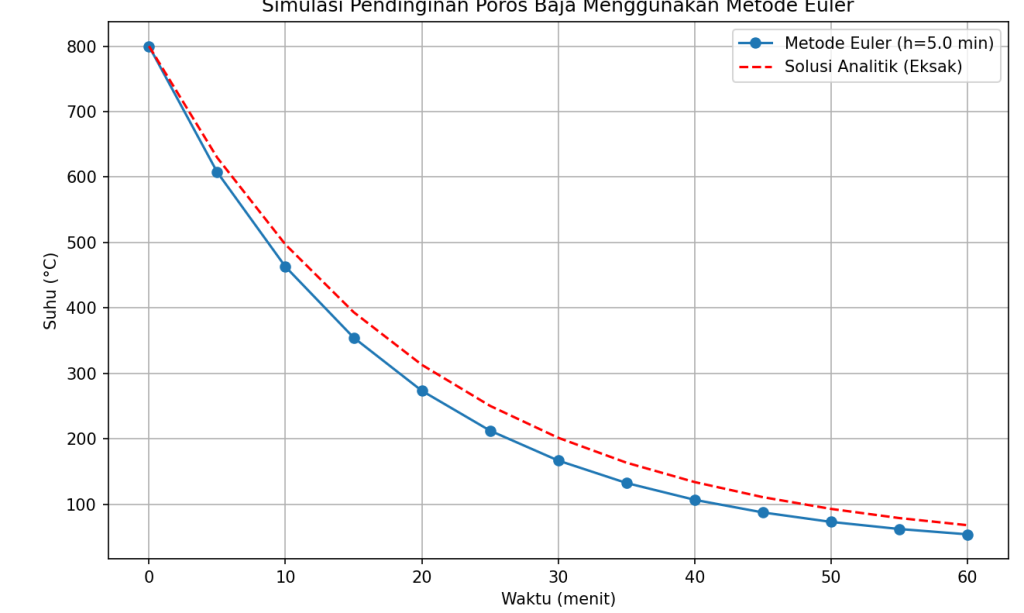
A direct comparison between the analytical solution and the Euler forward numerical results demonstrates good agreement when a sufficiently small time step is employed. The temperature curves obtained from both approaches closely overlap across most of the simulation period, indicating that the numerical method accurately approximates the underlying physical model under stable discretization conditions.
When larger time steps are used, deviations between the numerical and analytical solutions become more pronounced, particularly at the initial phase of cooling. This discrepancy arises from the first-order nature of the Euler method, which introduces truncation errors that are amplified when temperature gradients are large. These findings highlight the importance of appropriate time-step selection in numerical thermal simulations.
H.3 Error Characteristics and Numerical Accuracy
Error analysis reveals that the maximum absolute error typically occurs at the early stages of the simulation, where the rate of temperature change is highest. As the system evolves toward equilibrium, the numerical error diminishes due to the reduced slope of the temperature curve.
From an engineering perspective, these results emphasize that numerical errors are not merely mathematical artifacts but can influence practical interpretations if not properly managed. Incorporating explicit error evaluation and validation steps ensures that the numerical outputs remain reliable and meaningful for decision-making purposes.
H.4 Verification, Validation, and Iterative Refinement
The analytical solution serves as a robust benchmark for verifying the correctness of the numerical implementation. The close correspondence between analytical and numerical results confirms that the algorithm and computational procedures are implemented correctly.
The iterative refinement process embedded in the workflow, particularly through time-step adjustment and ratio-based decision checks, reflects standard engineering practice. When numerical accuracy does not meet predefined criteria, the model can be rerun with refined parameters, ensuring a controlled balance between computational efficiency and solution accuracy.
H.5 Target Temperature Evaluation and Decision Logic
The additional logic implemented to evaluate target temperature conditions provides practical engineering insight beyond temperature prediction alone. By checking whether the target temperature is physically meaningful relative to the ambient temperature, the model avoids invalid or misleading interpretations.
Furthermore, the ratio-based decision gate ensures that the calculated cooling behavior remains within acceptable bounds. Once these conditions are satisfied, the time required to reach the target temperature is computed and reported, offering actionable information for process planning and control.
H.6 Engineering Implications and Sustainability Considerations
The modelling approach demonstrates that reliable thermal insights can be obtained using a simple and computationally efficient framework. By combining analytical validation with lightweight numerical simulation, the approach minimizes unnecessary computational overhead, supporting sustainable engineering practices.
The results also indicate that early-stage design decisions can be informed using such simplified models before committing to more resource-intensive simulations. This aligns with sustainable engineering principles by reducing energy consumption, computational cost, and design iteration waste.
H.7 Discussion in the Context of the DAI5 Framework
Within the DAI5 framework, the results are interpreted not only as numerical outputs but as part of a conscious and responsible problem-solving process. The integration of validation, error control, and decision logic reflects alignment between intention, idealization, and execution.
By grounding numerical results in physical interpretation and ethical engineering judgment, this work demonstrates that effective modelling is not solely about generating accurate numbers, but about understanding system behavior, managing uncertainty, and making informed, accountable engineering decisions.
I. Conclusion
Conclusion
This study has demonstrated the effective application of the DAI5 framework to the modelling of metal cooling using Newton’s Law of Cooling. By integrating conscious intention, clear idealization, and structured numerical execution, the cooling behavior of a heated metal exposed to a constant ambient environment was successfully predicted and analyzed. The analytical solution provided a reliable benchmark, while the Euler forward numerical method offered a practical and flexible approach for time-discretized simulation.
The results confirmed that the temperature evolution follows an exponential decay toward thermal equilibrium, consistent with fundamental heat transfer principles. Numerical accuracy was shown to be strongly dependent on time-step selection, highlighting the importance of error evaluation, verification, and iterative refinement in engineering simulations. The inclusion of decision logic for target temperature assessment further enhanced the practical relevance of the model.
Closing Remarks
Beyond numerical accuracy, this work emphasizes that engineering modelling is not merely a computational task but a responsible decision-making process. Through the DAI5 framework, the modelling workflow remained coherent from initial awareness and intention to execution and interpretation. The conscious treatment of assumptions, validation, and limitations reinforces ethical and accountable engineering practice.
The simplicity and transparency of the adopted approach demonstrate that elegant and physically grounded models can provide meaningful insights without unnecessary computational complexity. Such clarity is particularly valuable in educational contexts and early-stage engineering design.
Recommendations
Based on the findings of this study, several recommendations and future directions are proposed:
- Model Extension
Future work may extend the model to include additional heat transfer mechanisms, such as thermal radiation or variable convective coefficients, to improve accuracy at higher temperatures. - Higher-Order Numerical Methods
Implementing higher-order numerical schemes (e.g., Runge–Kutta methods) could reduce numerical error while maintaining computational efficiency. - Experimental Validation
Integrating experimental cooling data would allow further validation of the model and calibration of the cooling constant for specific materials and geometries. - Scalability and Application
The framework can be adapted to other thermal processes, such as heating, quenching, or transient thermal response in different engineering systems. - DAI5-Based Engineering Practice
The DAI5 framework is recommended as a guiding structure for future engineering analyses, particularly where ethical responsibility, clarity of intention, and technical rigor must coexist.
J. Acknowledgments
The author expresses sincere gratitude to Prof DAI as the lecturer and my class peers who provided guidance and constructive feedback throughout the completion of this work.
K. (References) Literature Cited
Fedorov, D. V. (2010). Introduction to numerical methods with examples in JavaScript [Lecture notes]. Department of Physics and Astronomy, Aarhus University.
Siswantara, A. I. (2025, July 17). DAI5 “Deep Awareness of I”. UI Publishing.
Incropera, F. P., DeWitt, D. P., Bergman, T. L., & Lavine, A. S. (2011). Fundamentals of Heat and Mass Transfer (7th ed.). John Wiley & Sons.
https://drive.google.com/drive/folders/1i75H3JFdI_7NKGAc7oELykeipW0qZPkF LINK DRIVE
L. Lampiran Video
Penjelasan Video DAI5 Framework + 33 Elemen of DAI5
