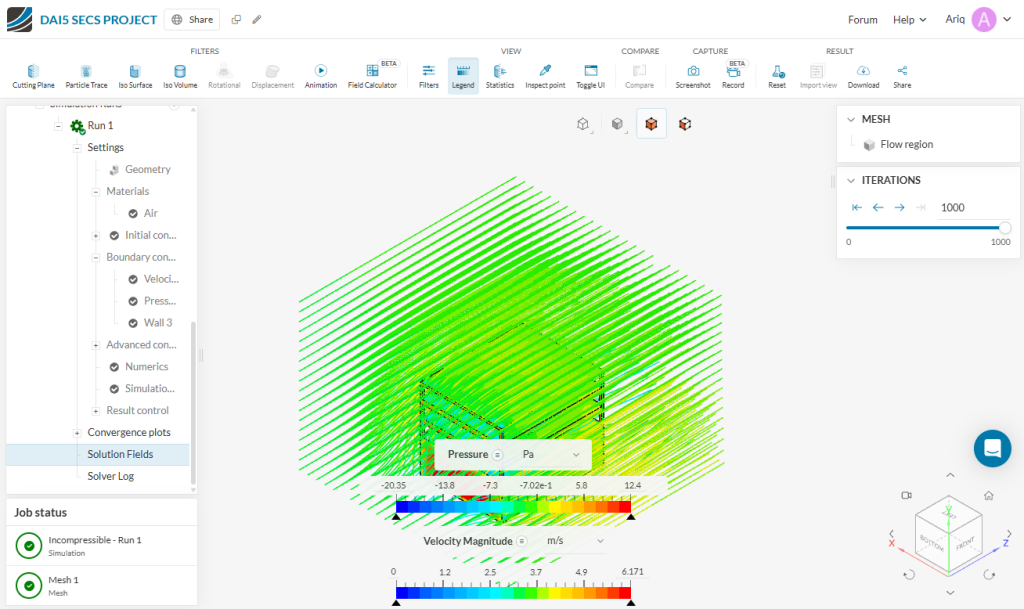
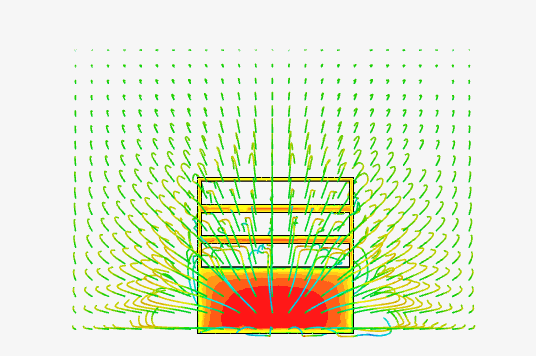
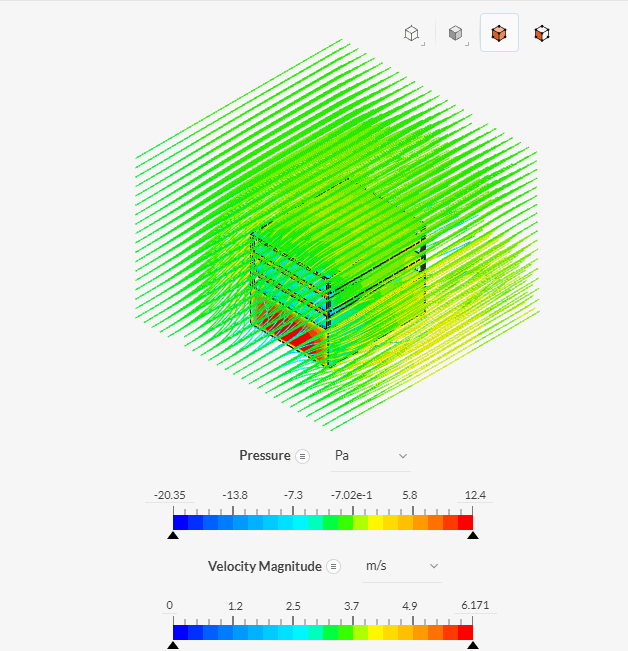
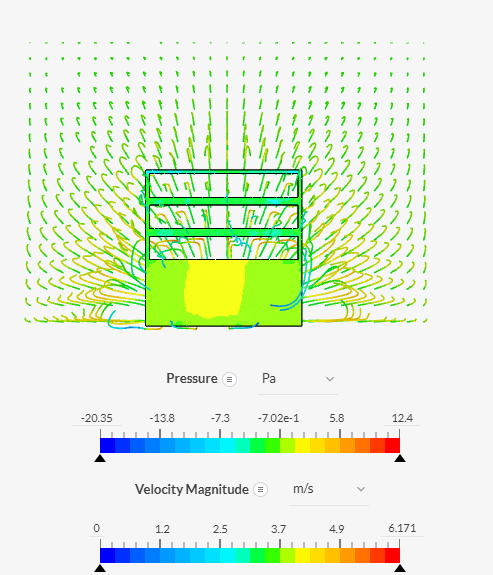
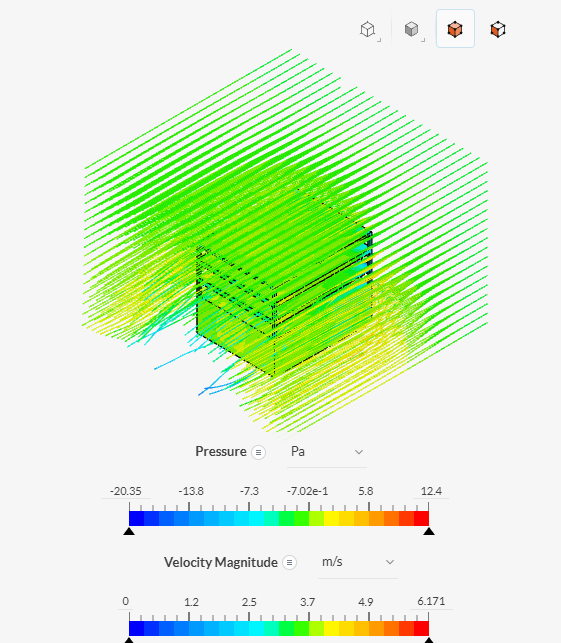
The simulation reveals a complex airflow pattern around the building structure. The model displays both pressure distribution (ranging from -20.35 to 12.4 Pa) and velocity magnitude (ranging from 0 to 6.171 m/s). At the approach velocity of 3 m/s, which falls in the middle of the velocity scale (shown in light green), the airflow demonstrates significant interactions with the building geometry.
As the air approaches the building, it creates a positive pressure zone on the windward face, evident from the yellowish regions indicating positive pressure values. This pressure buildup forces the airflow to accelerate around the building’s edges and through any openings. The simulation reveals that air velocity increases substantially at these points, reaching up to 4.9-6.171 m/s (yellow to red regions), creating areas of accelerated flow.
On the leeward side of the building, negative pressure zones form (shown in blue with values around -13.8 to -20.35 Pa). These low-pressure areas create suction effects that pull air around the building and may cause turbulence or recirculation zones. The vector lines clearly show how the airflow separates and curves around the structure, with some potential for vortex formation in these regions.
The horizontal stratification in the flow pattern suggests that the building creates distinct vertical zones of influence. Near the ground level, the flow appears more complex, likely due to interaction with the ground boundary layer. At higher elevations, the flow becomes more uniform, gradually returning to the free-stream conditions of 3 m/s.
Within and around the building structure itself, the model shows a channeling effect through openings, which would significantly impact indoor ventilation. The acceleration of air through these constricted spaces could provide enhanced natural ventilation but might also create uncomfortable drafts if not properly managed in the architectural design.
