This thesis investigates lid-driven cavity flow, a classical fluid dynamics problem used to benchmark computational fluid dynamics (CFD) models. The study combines experimental and numerical approaches to analyze the flow behavior within a square cavity under both laminar and turbulent conditions, focusing on the effects of lid acceleration and turbulence modeling.
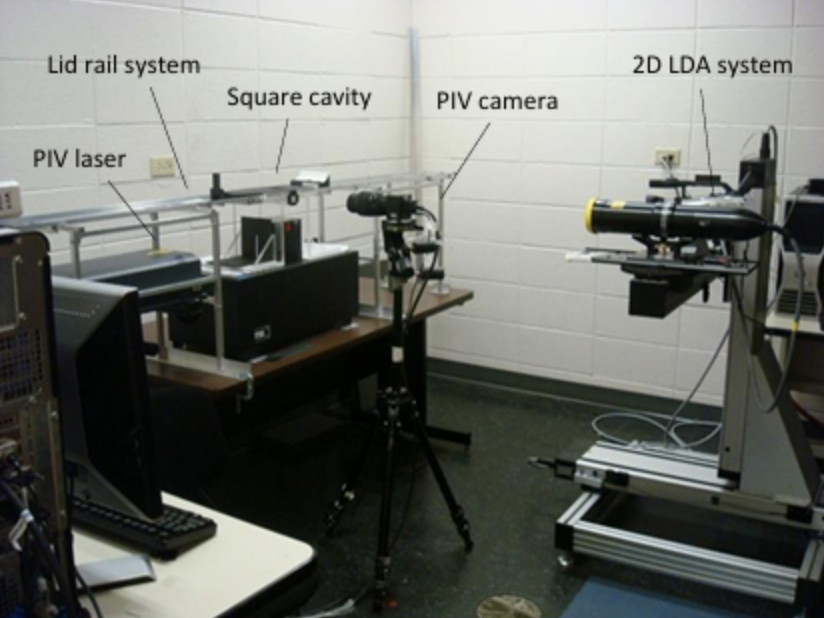
Particle Image Velocimetry (PIV) and Laser Doppler Anemometry (LDA) were employed to capture the velocity field in the cavity. PIV utilizes tracer particles and pulsed laser illumination to generate velocity vector maps, while LDA provides high-precision local velocity measurements. The experimental setup was designed to capture both global and local flow characteristics, with results processed to visualize the flow dynamics clearly.

CFD simulations were performed using ANSYS Fluent, where the solution domain was discretized with the Finite Volume Method (FVM). The pressure-based solver, ideal for incompressible flow, was applied with a laminar viscous model. The study included mesh independence and time-step independence tests to validate the numerical methods. The Reynolds-Averaged Navier-Stokes (RANS) equations with the k-ε turbulence model were used to simulate turbulent flows and compare with experimental data.
The PIV measurements showed a good agreement with LDA for horizontal velocity profiles, especially in the laminar regime. Transient flow behavior, influenced by lid acceleration, led to sharp velocity peaks during the transition from stagnation to steady-state flow. The CFD results were validated against experimental data, demonstrating good correlation in most areas, though the CFD significantly overestimated velocities near the center of the cavity in laminar flows.
In conclusion, the research highlights the importance of accurate turbulence modeling and mesh refinement in CFD simulations for lid-driven cavity flow, while demonstrating the effectiveness of PIV and LDA for experimental validation. The study provides valuable insights into the dynamics of both laminar and turbulent regimes, with potential applications in industrial processes and flow behavior analysis.
