The study of lid-driven cavity flow is one of the fundamental problems in fluid mechanics, widely used as a benchmark for computational fluid dynamics (CFD) validation. The simplicity of its geometry, combined with its complex flow behavior at different Reynolds numbers, makes it an excellent case for investigating both laminar and turbulent flow regimes. In this thesis, Abdullah Bin Naeem presents a comprehensive numerical and experimental analysis of lid-driven square cavity flow under both steady and unsteady conditions, with particular focus on the calibration of experimental data using computational methods.
The lid-driven cavity problem is extensively studied due to its relevance in various industrial and natural applications. In industries, it is used to model film melt spinning processes, microcrystalline material production, and continuous drying techniques. In nature, it is used to simulate sediment transport and impurity dispersion in water bodies. Due to its importance, numerous studies have been conducted to understand the flow dynamics of lid-driven cavities. However, the accuracy of experimental and numerical results often varies, necessitating careful validation and calibration.
The objective of this thesis is to conduct a detailed experimental and numerical investigation of lid-driven square cavity flow under both laminar and turbulent regimes. The experimental setup was developed at the University of New Orleans, utilizing advanced flow measurement techniques such as Particle Image Velocimetry (PIV) and Laser Doppler Anemometry (LDA). The numerical analysis was conducted using a commercial CFD solver, implementing the Reynolds-Averaged Navier-Stokes (RANS) equations with a k-epsilon turbulence model for turbulent flow cases.
Extensive research has been conducted on lid-driven cavity flow, both experimentally and numerically. The most notable numerical study was conducted by Ghia et al. (1982), which remains a benchmark for validating numerical simulations. Their study employed a finite difference method to solve the incompressible Navier-Stokes equations for Reynolds numbers ranging from 1,000 to 10,000. More recent studies, such as those by Erturk and Gokcol (2002), have extended the numerical analysis to higher Reynolds numbers, up to 21,000, using a finite volume solver.
Experimental studies have primarily utilized non-intrusive flow measurement techniques such as PIV and LDA. Kosseff and Street (1981) were among the first to use LDA to measure velocity profiles inside a cavity, while Migeon (1999) employed a particle streak technique to study vortex formation within the cavity. More recently, Faure (2008) conducted PIV experiments to investigate the effects of external shear layers on cavity flow behavior at Reynolds numbers ranging from 1,900 to 12,000.
Other numerical approaches, such as Direct Numerical Simulations (DNS) and Large Eddy Simulations (LES), have also been applied to study turbulent lid-driven cavity flow. DNS offers highly accurate results by solving the full Navier-Stokes equations without any turbulence modeling, but it is computationally expensive. LES, on the other hand, models only the smallest turbulent eddies while directly simulating the larger structures, striking a balance between accuracy and computational feasibility. These methods have been employed in studies such as those by Leriche & Gavrilakis (1999) and Pradhan & Kumaran (2003), demonstrating their effectiveness in predicting turbulent cavity flows.
The experimental setup for this study was designed to capture both global and local velocity distributions within the cavity. A transparent plexiglass cavity with dimensions 1 inch x 1 inch x 5 inches was used to ensure two-dimensional flow characteristics. The top lid was driven by a precision motor system to maintain a constant velocity, while the cavity was filled with deionized water seeded with 10-micron silver-coated hollow glass spheres for PIV analysis.
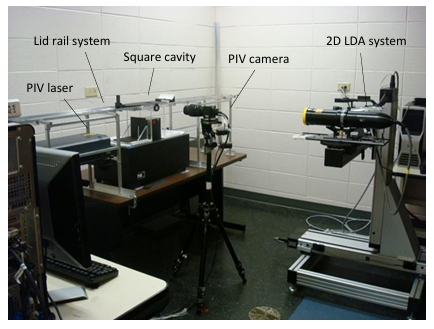
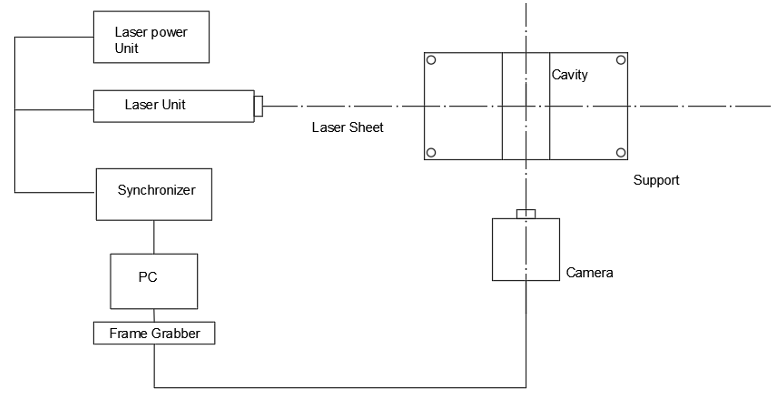
The two primary measurement techniques used in this study were:
- Particle Image Velocimetry (PIV): Used for capturing global velocity distributions by illuminating the seeded flow with a dual-cavity Nd:YAG laser and recording the scattered light using a high-resolution CCD camera.
- Laser Doppler Anemometry (LDA): Used to obtain high-precision local velocity measurements by analyzing the Doppler shift of laser light scattered by moving particles.
The PIV and LDA measurements were compared to evaluate the accuracy of each technique. The PIV results provided detailed velocity vector fields and streamline plots, which were validated using the LDA measurements. It was observed that PIV overestimated velocity magnitudes compared to LDA, particularly near the cavity walls. The calibration study revealed that the horizontal velocity profiles measured by PIV and predicted by the CFD solver were in good agreement, but both overestimated LDA measurements.
The numerical analysis was based on the incompressible Navier-Stokes equations, which govern the motion of viscous fluid flows. The continuity and momentum equations used in this study were:
- Continuity Equation:
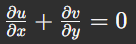
2. Momentum Equations:
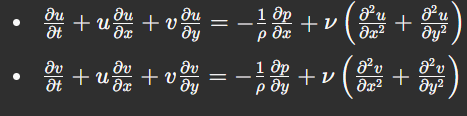
For turbulent cases, the RANS equations were employed with the k-epsilon turbulence model.
To ensure numerical accuracy, a series of validation and verification steps were conducted:
- Mesh Independence Study: The optimal mesh size was determined to be 61 x 61 for 2D and 121 x 121 x 121 for 3D simulations.
- Time Step Independence Study: A second-order implicit time-stepping method was used to verify time-dependent simulations.
- Comparison with Benchmark Data: The numerical results were validated against Ghia et al. (1982) for laminar cases and experimental data from literature for turbulent cases.
This study provided valuable insights into the dynamics of lid-driven cavity flow. The experimental and numerical results showed good agreement, but some discrepancies were noted due to differences in measurement techniques. The calibration study highlighted the importance of using LDA data to refine PIV measurements.
For future research, it is recommended to:
- Implement Large Eddy Simulations (LES) or Direct Numerical Simulations (DNS) for more accurate turbulence modeling.
- Extend the study to non-Newtonian fluids to explore industrial applications.
- Investigate 3D effects at higher Reynolds numbers to understand secondary flow structures.
- Explore alternative turbulence models, such as Shear Stress Transport (SST) k-ω, which may offer improved accuracy in predicting near-wall turbulence behavior.
This research contributes to the field of fluid mechanics by improving the understanding of lid-driven cavity flow and refining experimental techniques for flow measurement. The findings are expected to benefit both academic research and industrial applications involving internal fluid flows.
