Introduction
Assalamualaikum wr wb, This post provides a comprehensive scientific discussion on the principles of mechanical fluids and CFD analysis. Furthermore, it explores how CFD operates within the structured framework of DAI 5, a methodological approach that ensures systematic problem-solving. Additionally, a detailed explanation of the Navier-Stokes equations and cavitation mechanics is provided, followed by an analysis of how CFD simulations can be utilized to study these phenomena while employing DAI 5 as a structured framework for computational modeling and solution development.
Understanding CFD and Its Role in Mechanical Fluids
Computational Fluid Dynamics (CFD) is a numerical approach used to solve and analyze fluid flow problems. By employing discretization methods such as the Finite Volume Method (FVM), Finite Element Method (FEM), and Finite Difference Method (FDM), CFD enables engineers to approximate solutions for governing equations like the Navier-Stokes equations. These equations describe the fundamental principles of mass conservation, momentum conservation, and energy conservation within a fluid domain.
CFD simulations are widely used in engineering applications, including aerodynamic design, weather modeling, biomedical flows, and energy systems. One of its key advantages is the ability to visualize flow fields, pressure distributions, and turbulence effects, which are otherwise difficult to measure experimentally. In complex scenarios, such as cavitation in pumps or turbulence in aircraft aerodynamics, CFD serves as a powerful predictive tool to optimize designs and enhance performance.
The DAI 5 framework introduces a structured methodology for problem-solving in engineering analysis. It ensures that CFD simulations are not conducted arbitrarily but follow a logical sequence of awareness, intention, and execution. The five core steps of DAI 5, when applied to CFD analysis, are as follows:
- Deep Awareness of I : This step involves understanding the fundamental principles of fluid dynamics, identifying the problem, and recognizing the significance of the simulation. In the context of cavitation analysis, this includes understanding the effects of low-pressure zones and bubble dynamics in fluid machinery.
- Intention : Clearly defining the objectives of the CFD study, such as reducing cavitation damage in turbines or optimizing airflow over an airfoil. This step ensures that computational resources are utilized effectively with a clear goal in mind.
- Initial Thinking : Establishing the necessary equations, boundary conditions, and computational domain setup. This step includes selecting the appropriate turbulence and cavitation models, determining mesh quality, and choosing solvers for accurate results.
- Idealization : Developing a computational model that simplifies reality while maintaining physical accuracy. This step includes mesh generation, grid independence studies, and choosing appropriate numerical discretization techniques.
- Instruction Set : Implementing the simulation, running solvers, and analyzing results systematically. This step ensures that insights gained from CFD simulations align with experimental or real-world data for validation.
By integrating DAI 5 into CFD workflows, engineers ensure a methodological, systematic, and purpose-driven approach to solving fluid mechanics problems.
Navier-Stokes Equations: The Foundation of Fluid Dynamics
Fluid dynamics plays a crucial role in understanding how liquids and gases move and interact with their surroundings. From the airflow around an aircraft wing to the movement of water in pipelines and the combustion gases inside an engine, accurately predicting fluid behavior is essential for engineering, environmental studies, and various industrial applications.
To mathematically describe these fluid motions, scientists and engineers rely on the Navier-Stokes Equations. These equations are fundamental because they represent the conservation of mass, momentum, and energy in a fluid system, accounting for the effects of pressure, viscosity, and external forces.
Without the Navier-Stokes Equations, it would be impossible to accurately simulate how fluids behave under different conditions. They are the core of Computational Fluid Dynamics (CFD), allowing us to model fluid interactions in applications such as aerodynamics, hydrodynamics, and climate simulations.
Compressible vs. Incompressible Flow
One of the key aspects of fluid behavior described by the Navier-Stokes Equations is whether a fluid is considered compressible or incompressible. This distinction depends on whether the fluid’s density remains constant or varies significantly during motion.
1. Incompressible Flow
An incompressible flow assumes that the fluid density remains constant throughout its motion. This is often a valid assumption for liquids, as their density does not change significantly under typical pressure variations. It is also used for low-speed gas flows, where changes in pressure and temperature are small enough that density remains nearly unchanged.
The mathematical simplification for incompressible flow is that the continuity equation (mass conservation) reduces to:

This means that the velocity field is divergence-free, ensuring that the amount of fluid entering a control volume equals the amount leaving it. Because density is constant, the equations become easier to solve, making incompressible flow analysis widely applicable in engineering fields such as hydraulic systems, ventilation, and cooling systems.
2. Compressible Flow
A flow is considered compressible when the fluid density varies significantly due to changes in pressure and temperature. This behavior is common in gases, particularly at high speeds, such as in supersonic and hypersonic flows around aircraft, jet engines, and rocket propulsion systems.
For compressible flows, the continuity equation must account for density variations:
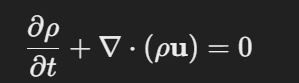
Additionally, the energy equation becomes crucial, as changes in temperature directly affect density. In high-speed flows, compressibility effects lead to shock waves, expansion waves, and varying thermodynamic properties, requiring a more complex analysis compared to incompressible flow.
A key parameter for distinguishing between compressible and incompressible flow is the Mach number (Ma), which represents the ratio of fluid velocity to the speed of sound:
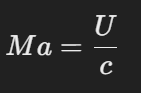
- If Ma<0.3Ma < 0.3Ma<0.3, the flow is generally considered incompressible, as density changes are negligible.
- If Ma>0.3Ma > 0.3Ma>0.3, compressibility effects become significant and must be accounted for in fluid calculations.
Mathematical Formulation of the Navier-Stokes Equations
The Navier-Stokes Equations consist of three fundamental conservation laws:
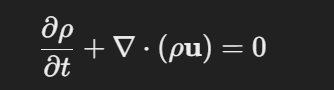
1. Mass Conservation (Continuity Equation)
The continuity equation ensures that mass is neither created nor lost within a control volume:
2. Momentum Conservation (Newton’s Second Law for Fluids)
The momentum equation describes how the velocity of the fluid changes due to forces acting on it:

This equation applies to both compressible and incompressible flows, but in compressible cases, density ρ\rhoρ is not constant and must be computed dynamically.
3. Energy Conservation (First Law of Thermodynamics for Fluids)
In compressible flows, the energy equation becomes essential, as changes in pressure and velocity also affect temperature and density:

For incompressible flows, energy considerations are often simplified, while for compressible flows, the equation becomes a crucial part of the analysis.
Cavitation and Its Impact on Fluid Dynamics
Cavitation occurs when the local pressure in a fluid drops below its vapor pressure, leading to the formation of vapor bubbles. These bubbles collapse violently, generating shockwaves that can cause damage to mechanical components, increased noise, and efficiency losses in systems like pumps, turbines, and propellers.
Causes of Cavitation
- High fluid velocity – Leads to localized low-pressure zones.
- Sudden changes in flow direction – Occurs at sharp bends, valves, or blade edges.
- Obstructions in the flow path – Creates pressure fluctuations and vortex formations.
- High temperatures – Lowers vapor pressure, increasing the risk of cavitation.
Effects of Cavitation
- Erosion of surfaces – Rapid bubble collapse damages impeller blades and pipe walls.
- Reduction in efficiency – Energy loss due to unwanted vapor phase formation.
- Vibration and noise – Structural integrity is compromised due to pressure fluctuations.
Mathematical Model: Rayleigh-Plesset Equation
The Rayleigh-Plesset equation is used to describe the growth and collapse of cavitation bubbles:

This equation models the dynamics of cavitation bubbles, accounting for pressure variations, surface tension, and viscous effects, making it a key tool for predicting cavitation onset in fluid systems.
Methods to Mitigate Cavitation
- Increasing system pressure – Prevents pressure drops below vapor pressure.
- Optimizing blade and pipe geometry – Reduces abrupt pressure changes.
- Using anti-cavitation coatings – Protects surfaces from erosion damage.
How Navier-Stokes Equations Relate to Cavitation
The Navier-Stokes equations provide a mathematical foundation for analyzing cavitation by describing how velocity, pressure, and density interact in fluid systems. Cavitation is primarily a pressure-driven phenomenon, and the momentum equation from Navier-Stokes helps explain the formation and collapse of vapor bubbles:
- The pressure gradient term (-∇p) determines where pressure drops occur, identifying potential cavitation zones.
- In regions of high velocity, such as around pump impellers or turbine blades, pressure can decrease significantly, causing local cavitation.
- When bubbles collapse, intense pressure spikes occur, which can be analyzed using Navier-Stokes equations coupled with cavitation models in CFD simulations.
By incorporating Navier-Stokes in CFD models, engineers can predict and mitigate cavitation, improving the reliability and efficiency of fluid systems.
How CFD Analyzes Cavitation and Navier-Stokes using DAI 5 Framework
Applying DAI 5 to CFD cavitation analysis involves:
- Establishing awareness of cavitation risks and fluid behavior (DAI).
- Defining simulation goals, such as reducing vapor bubble formation (Intention).
- Setting up numerical models using Navier-Stokes and Rayleigh-Plesset equations (Initial Thinking).
- Idealizing the problem to optimize computational efficiency (Idealization).
- Implementing CFD solvers, analyzing results, and validating with experimental data (Instruction Set).
