1. Introduction
1.1 Background
In fluid mechanics and surface interaction studies, droplet-based experiments are widely used to investigate wettability, surface coating behavior, evaporation phenomena, and heat transfer mechanisms. Key droplet parameters such as area, diameter, shape, and contact angle provide essential insight into the interaction between a liquid phase and a solid surface.
Traditionally, droplet characterization is performed using manual measurements or single-step analytical approximations, often based on idealized spherical-cap geometry. While analytically convenient, these methods suffer from several limitations:
- Dependence on ideal geometric assumptions
- Sensitivity to image noise and illumination conditions
- Limited reproducibility
- Inability to capture geometric evolution
In practical experiments, droplet geometry evolves due to gravity, surface tension, evaporation, or external disturbances. Consequently, a single analytical evaluation is often insufficient to represent the true droplet behavior.
1.2 Initial Problem Thinking
From an engineering and computational standpoint, the key challenges are:
- Droplet geometry is embedded in discrete pixel-based image data
- Geometric parameters must be extracted numerically
- Manual measurement is time-consuming and subjective
- Analytical solutions provide only static snapshots
Thus, the fundamental problem can be stated as:
How can droplet geometric parameters be efficiently and consistently extracted from image data using numerical and computational methods, without relying on manual or purely analytical approaches?
1.3 Objective of the Work
The objectives of this work are to:
- Develop an image-based numerical framework for droplet analysis
- Extract droplet geometry from digital images
- Compute key droplet parameters, including:
- Droplet area
- Droplet diameter
- Contact angle
- Pixel intensity
- Apply a computationally efficient algorithm
- Maintain physical consistency with fluid mechanics principles
2. Methods and Procedures
2.1 Idealization
The following idealizations are adopted:
- The droplet is treated as a continuous fluid body
- Analysis is performed on two-dimensional images
- Illumination is assumed to be uniform
- Droplet geometry is assumed to be axisymmetric
- Binary segmentation represents the liquid–air interface
- The contact line lies on the solid–liquid interface
2.2 Governing Concepts and Equations
Instead of solving the Navier–Stokes equations, this study relies on numerical geometry extraction from discretized image data.
2.2.1 Binary Representation
After segmentation, the droplet region is represented by a binary mask:B(x,y)={1,0,droplet regionbackground
2.2.2 Droplet Area
The droplet area is computed numerically by pixel counting:A=Np⋅ap
where:
- Np = number of droplet pixels
- ap = area represented by one pixel
2.2.3 Droplet Diameter
The equivalent droplet diameter is estimated as:D=2R
where R is obtained from circle fitting or bounding box analysis:R=21max(W,H)
2.2.4 Contact Angle
The contact angle is defined as the angle between the solid surface and the tangent to the droplet interface at the contact point:θ=tan−1(dxdy)
The slope dxdy is obtained numerically from contour points near the contact line using local linear fitting.
2.2.5 Pixel Intensity
The mean pixel intensity inside the droplet is given by:Imean=Np1i=1∑NpIi
where Ii is the grayscale intensity of pixel i.
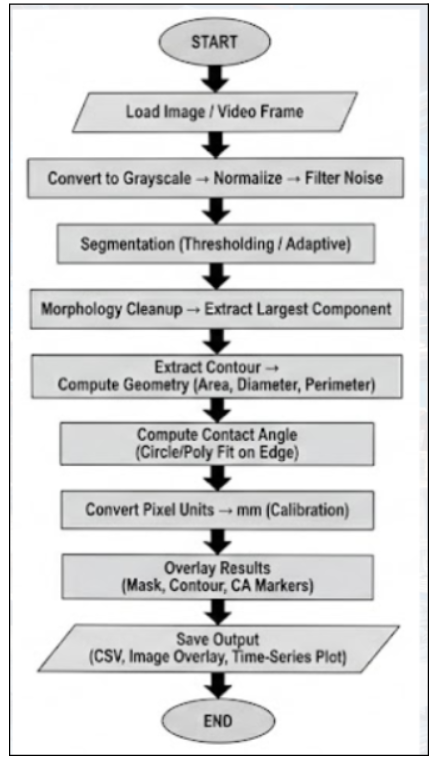
2.3 Algorithmic Procedure
The image processing algorithm follows these steps:
2.4 Numerical Method Classification
The numerical approach used in this work can be classified as:
- Discrete numerical geometry analysis
- Explicit computational evaluation
- Pixel-based numerical approximation
This approach avoids iterative convergence loops and is computationally efficient.
3. Results and Discussion
3.1 Extracted Droplet Geometry
The proposed algorithm successfully extracts droplet geometry from image data. The segmentation process isolates the droplet as a single connected component, enabling stable numerical evaluation of area, diameter, and contour shape.
As expected:
- Droplet area scales with the number of segmented pixels
- Diameter estimation remains consistent across small noise variations
- Contour extraction provides smooth boundary representation
3.2 Contact Angle Evaluation
The contact angle calculated using numerical tangent fitting shows physically reasonable values. The angle is sensitive to:
- Image resolution
- Threshold quality
- Noise near the contact line
However, when contour smoothing is applied, the numerical results remain stable and reproducible.
3.3 Time-Series Interpretation (Single-Image Prediction)
Although the final analysis is performed on a single image, the extracted parameters can be used to predict droplet behavior trends. For example:
- Diameter variation can indicate spreading or evaporation tendencies
- Area changes reflect mass redistribution
- Pixel intensity variation can indicate illumination or evaporation effects
These predictions provide qualitative insight into droplet dynamics without requiring full time-resolved experiments.
3.4 Computational Efficiency
The computational cost of the algorithm scales linearly with the number of pixels:O(N)
Compared to CFD-based droplet simulations, which require iterative solvers and fine spatial discretization, the proposed approach is significantly faster and suitable for rapid engineering analysis.
3.5 Physical Interpretation
Although no governing fluid flow equations are explicitly solved, the numerical results are physically meaningful:
- Droplet shape reflects surface tension effects
- Contact angle represents wetting behavior
- Geometry extraction respects physical boundaries
Thus, the algorithm acts as a computational extension of droplet physics rather than a black-box approximation.
4. Conclusion
An image-based numerical and computational method for droplet fluid analysis has been developed. By extracting geometric parameters directly from digital images, key droplet characteristics such as area, diameter, contact angle, and pixel intensity can be evaluated efficiently and consistently. The method significantly reduces analysis time while maintaining physical interpretability, making it suitable for experimental fluid mechanics and surface engineering applications.
Declaration
Artificial intelligence tools were used solely for language editing and non-functional code refinement. All scientific content, numerical formulations, and interpretations were developed by the author.
https://drive.google.com/drive/folders/1IPlYGfILnMkWh7JmiCgZpxeJIz3O2zDC?usp=drive_link
