A. Project Title
3D Print Technology in Automotive Industry of Intake System Application at UI racing team 2025
B. Author Complete Name
Zaahir Faizi Zuhrah (2306263531)
C. Affiliation
Engine Division, Formula Student Team, Mechanical Engineer at Universitas of Indonesia
D. Abstract
This study digs into how 3D printing is used within the car industry, especially highlighting its function to advance and improve Formula Student cars’ air intakes. The project centers itself on the full design, along with testing, as well as implementation of a custom 3D-printed intake plenum that was developed through using various thermoplastic filaments including nylon-based composites as well as high-performance polymers. The mechanical integrity as well as the endurance of the components under realistic race conditions were each evaluated via tensile strength testing, modal analysis, as well as random vibration simulations. They then tested within the real world and assessed operational reliability and pressure resistance. The results do indicate that in the event engineers properly select material and bond by using certain techniques, 3D-printed components are able to perform well enough in order to run competition-level internal combustion engines. Several modern prototyping methods such as additive manufacturing accelerate development cycles. The work is also what maintains structural and functional integrity for it.
E. Author Declaration
1. Deep Awareness (of) I
In conducting this research and project, I remain deeply aware of my role as a humble learner and innovator, continuously reflecting on my responsibilities and potential contributions to society. I recognize this endeavor as a form of service—both to the pursuit of knowledge and the remembrance of The One and Only who grants us the ability to create, reflect, and improve.
2. Intention of the Project Activity
The intention behind this project is not solely technical advancement, but to explore sustainable, accessible manufacturing technologies that can empower student teams and engineers to innovate responsibly. This work aims to contribute ethically to engineering knowledge and to inspire others to pursue low-cost, high-efficiency design solutions with integrity.
F. Introduction
Additive manufacturing (AM), more commonly known as 3D printing, has rapidly expanded from prototyping into functional, load-bearing automotive applications. In the context of the Formula Student competition, design freedom, fast iteration, and budget constraints make AM particularly attractive. Our team identified the intake plenum—a complex, custom-shaped component limited by strict design rules and packaging—as an ideal candidate for 3D printing implementation.
Initial Thinking (about the Problem):
Intake systems must deliver optimal airflow to the engine while withstanding pressure fluctuations and vibrations. The mandatory 20 mm restrictor in Formula Student increases design complexity by introducing significant pressure drops. Traditional aluminum plenums are expensive and time-consuming to produce. Our aim was to explore whether a 3D-printed plenum could match or exceed performance targets, despite concerns over material strength, leakage, and heat resistance.
G. Methods & Procedures
Idealization:
We assumed the plenum operates under quasi-static pressure loads peaking at 4 bar during intake pulses. Material selection was based on tensile strength, thermal stability, and ease of printability. The plenum was designed in CAD and analyzed under FEA with ANSYS, assuming bonded boundary conditions and internal pressure loads. Modal and random vibration analyses simulated engine vibration conditions.
Material Consideration & Manufacturing
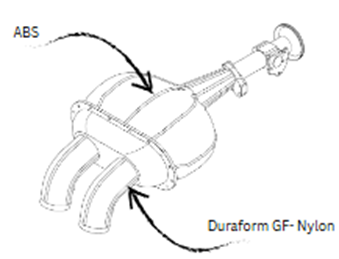
Design Geometry
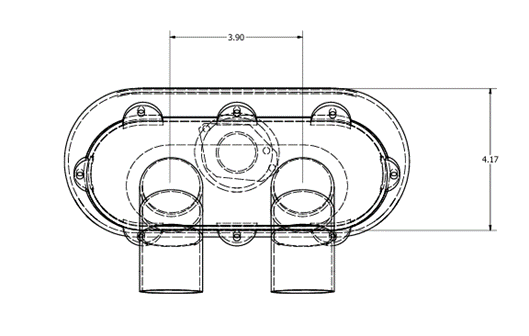
The fluid volume of the plenum is 5.2L, with a total mass of 650 g, not inclusive of throttle body and air filter. The runner thickness was set to 8mm as the air intake is essentially a cantilever and this is the area where experience high stresses cause by pressure wave changes. The plenum wall at areas was set at 5mm thickness and this number will get simulation on stress analysis as well as other variant.
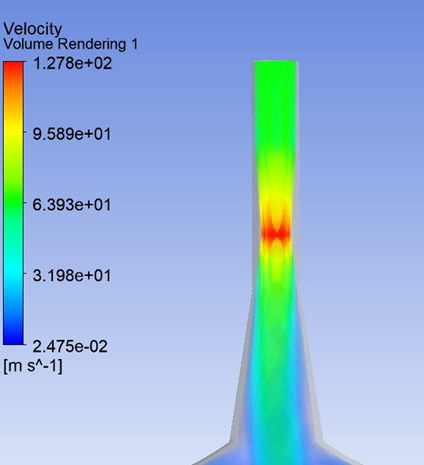
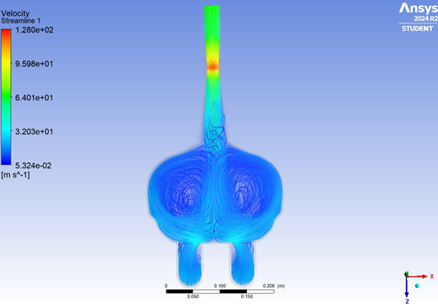
The result based on figure above represnting each velocity speed occurs in vary section of the restrictor and plenum neck. From figures above respectively, at no point does the restrictor choke during a full cycle with the maximum velocity magnitude experienced was Mach 0.37 number, far less than sonic flow of 343 m/s and we can conclude the choke effect does not occur in this section.
With knowing that the choke efffect will not occuring, we can validate our first step of geometry design and continuing other analysis such as stress analysis and random vibration analysis which will be explained further more. But, it is also important to seek trough of understanding the airflow of overall gemetry in which have various parameters such as turbulent air as well as mass flow rate.
Instruction (Set):
- CAD Modeling: SolidWorks and Fusion 360
- Filament Testing: PLA, ABS, Nylon, Duraform-GF Nylon
- Tensile Test: Conducted per ASTM D638
- Simulation: ANSYS (FEA, Modal, Random Vibration)
- Bonding: Epoxy adhesive putty and structural glue trials
- Real-World Testing: MAP sensor integration, idle and WOT behavior monitoring
- Validation: Leak tests, pressure retention, and performance under endurance test conditions
H. Results & Discussion
Initial tensile tests revealed that while PLA and ABS failed early, glass-filled nylon provided sufficient strength (yield stress ~75 MPa). FEA showed acceptable safety factors under pressure. Modal analysis identified a first natural frequency above the typical engine harmonic range, reducing the risk of resonance.
Random vibration analysis confirmed durability under engine mounting conditions. Bonding with industrial epoxy minimized leaks, though sealing remained a critical challenge. The plenum survived 4 bar pressure tests and over 30 minutes of runtime without failure during full throttle acceleration. MAP-based tuning showed improved throttle response over the previous aluminum version due to smoother internal geometries enabled by AM design freedom.
I. Conclusion, Closing Remarks, Recommendations
This study concludes that with using of the right materials and validation process, 3D-printed intake plenums are viable for competitive motorsport applications. Future work could explore multiple instances of multi-material printing. Also, carbon-fiber-reinforced polymers might be able to be explored. Also recommended can be thermal shielding and also further improvements in bonding techniques. As this research shows, innovations in vehicular design can be created powerfully as well as at low cost by AM paired with numerical methods.
J. Acknowledgments
Special thanks to the entire Formula Student team, our faculty advisor Pak Adhit, and the testing lab technicians for their invaluable support. Gratitude also goes to our sponsors for providing materials and simulation software access.
K. References (Literature Cited)
- Gibson, I., Rosen, D. W., & Stucker, B. (2021). Additive Manufacturing Technologies. Springer.
- ASTM D638 – Standard Test Method for Tensile Properties of Plastics
- Kalpakjian, S., & Schmid, S. (2014). Manufacturing Engineering and Technology. Pearson.
- ANSYS Inc. (2023). ANSYS Mechanical User’s Guide.
- Formula SAE Rules 2024. SAE International.
- MarketsandMarkets. (2022). 3D Printing in Automotive Market – Forecast to 2027.
L. Appendices
- Appendix A: CAD Model Images
- Appendix B: FEA Result Snapshots
- Appendix C: Tensile Test Raw Data
- Appendix D: Vibration Analysis Graphs
- Appendix E: Real-World Test Photos and Logs
