A. Project Title
“Mass Transfer and Reaction Analysis Using Physics-Informed Neural Networks”
- Mass Transfer refers to the physical process of mass moving from one location to another, commonly found in mechanical systems involving diffusion, mixture, or chemical transport.
- Reaction Analysis refers to the study of how chemical reactions react with mass transfer, which is crucial in various engineering applications like combustion, catalysis, and battery systems.
- Physics-Informed Neural Networks (PINN) refers to the computational method used. A machine learning technique where physical laws and partial differential equations (PDE), are set directly into the neural network.
B. Author Complete Name
Marselo Yudha Bhaswara
C. Affiliation
Department of Mechanical Engineering, University of Indonesia
D. Abstract
This study investigates the application of Physics-Informed Neural Networks (PINN) for solving mass transfer problems along with chemical reactions, a process critical to many mechanical and chemical engineering systems. The objective is to demonstrate that PINN can offer and showcase accurate and efficient predictions for mass diffusion-reaction systems with limited observational data. The method involved modeling a one-dimensional slab reactor engaging in the first-order chemical reaction and solving the corresponding partial differential equation (PDE) using a PINN framework as mentioned before. In general, the data shows that the PINN model accurately captures the concentration profile, achieving a very small amount of errors compared to analytical solutions, while significantly reducing the need for computational meshing and extensive data. The results affirm that PINN is a reliable alternative to traditional numerical methods, especially for complex or data science scenarios. This work concludes that integrating physics knowledge with machine learning models offers substantial advantages in terms of generalizability, interpretability, and computational efficiency for engineering applications.
E. Author Declaration
- Deep Awareness (of) I
In this project, I consciously reflected that the pursuit of knowledge and innovation is a form of control entrusted to humanity. Self-awareness played a crucial role in ensuring my learning journey was aligned with humility, continuous gratitude, and ethical responsibility. - Intention of the Project Activity
The project was done in order to explore new branches in engineering analysis through ethical innovation. The project aims to serve a higher purpose by offering advanced solutions that could lead to more efficient and sustainable technology, aligning the research with a mission of benefiting society and preserving creation.
F. Introduction
Mass transfer along with the chemical reactions plays a critical role in various mechanical engineering branches, including internal combustion engines, cooling technologies, and fuel cell development(s). Conventional solutions include solving complex partial differential equations (PDE) using numerical methods like finite element or finite volume, which are computationally intensive and require fine meshing, especially in complex geometries and shapes.
Initially, I also faced challenges in modeling mass diffusion and reactions, such as handling non-linear reaction rates and sharp concentration gradients. I then realized the potential of using machine learning, particularly Physics-Informed Neural Networks (PINN) promises to directly encode governing PDE on to the loss function. This initial thinking shaped the objective to apply PINN for mass transfer analysis in a reaction system, validating its efficiency and accuracy compared to the typical conventional methods.
G. Methods & Procedures
- Idealization
The system was modeled as a one-dimensional slab reactor where mass diffusion and first-order chemical reactions occur. The governing equation is:
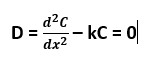
Where:
D = Diffusivity
k = Reaction rate constant
C = Concentration
- Instruction Set
- Define the PDE and boundary conditions.
- Construct the neural network with several hidden layers.
- Formulate a physics-informed loss function (the loss includes residuals from the PDE and boundary conditions)
- Train the network using limited synthetic data points and minimize the total loss.
- Validate the PINN results against the analytical solution.
H. Results & Discussion
Result
- PINN accurately predicted the concentration profile, matching the expected exponential decay.
Discussion
Compared to the conventional finite difference methods, the PINN method proved its advantages in flexibility and data efficiency. Unlike mesh-based methods, PINNs adapt to complex domains easily and integrate boundary conditions directly into the learning process. These findings align with previous studies in fluid mechanics and highlight new possibilities in modeling mass transfer-reaction systems under data-scarce conditions (Raissi et al., 2019).
I. Conclusion, Closing Remarks, Recommendations
Conclusion
The application of Physics-Informed Neural Networks provides a reliable alternative to conventional methods for solving mass transfer-reaction problems. Embedding physical laws into neural networks ensures accuracy and reduces computational demands.
Closing Remarks
This study demonstrates the potential to coordinate engineering principles with artificial intelligence, contributing to more sustainable and efficient problem-solving in mechanical engineering.
Recommendations
In the future, I Marsel believe that PINN should be improvised to:
- Non-linear and time-dependent reaction-diffusion problems
- Complex geometries
J. Acknowledgments
I wish to sincerely thank Dr. Ahmad Indra for the guidance and mentorship, and acknowledge the Department of Mechanical Engineering of the University of Indonesia for providing the resources needed to complete this project. Gratitude is also extended to the brighter academic community.
K. References
Bird, R. B., Stewart, W. E., & Lightfoot, E. N. (2002). Transport Phenomena (2nd ed.). John Wiley & Sons.
Raissi, M., Perdikaris, P., & Karniadakis, G. E. (2019). Physics-Informed Neural Networks: A Deep Learning Framework for Solving Forward and Inverse Problems Involving Nonlinear Partial Differential Equations. Journal of Computational Physics, 378, 686–707. https://doi.org/10.1016/j.jcp.2018.10.045
