Introduction to PiNN in CFD
Computational Fluid Dynamics (CFD) is an essential tool used to simulate and analyze fluid flow in various engineering applications, ranging from aerodynamics to heat exchangers. Traditional CFD methods, such as the Finite Volume Method (FVM) and Finite Element Method (FEM), require extensive computational resources due to the need for fine mesh discretization and iterative numerical solutions. These methods can be time-consuming and computationally expensive, especially when dealing with complex geometries and transient flow phenomena.
Physics-Informed Neural Networks (PiNN) provide an alternative approach by embedding physical laws directly into neural network architectures. Instead of relying solely on large simulation datasets, PiNNs incorporate governing equations, such as the Navier-Stokes equations, within their training process. This allows PiNNs to solve fluid dynamics problems more efficiently while reducing reliance on traditional meshing techniques. By leveraging the power of deep learning and physics-based constraints, PiNNs offer a promising method for solving CFD problems with improved accuracy and reduced computational costs.
Understanding How PiNN Works
PiNNs operate by integrating fundamental physical principles directly into the neural network’s loss function, allowing them to solve differential equations governing fluid dynamics without the need for extensive labeled datasets. The core idea behind PiNNs is to train a neural network to approximate the solution of partial differential equations (PDEs) by minimizing the residuals of these equations. Instead of learning from data alone, the network is informed by physical laws, ensuring that its outputs adhere to the expected behavior dictated by governing equations such as the Navier-Stokes equations.
The training process of a PiNN involves the following key steps:
- Defining the Physics-Based Loss Function – The loss function is composed of multiple terms, including residuals from the governing equations, boundary conditions, and initial conditions. By penalizing deviations from these physical constraints, the network is guided toward an accurate solution.
- Sampling Collocation Points – Unlike conventional deep learning approaches that rely on structured datasets, PiNNs use collocation points, which are randomly sampled within the domain to evaluate the residuals of the governing equations. This reduces the dependency on large datasets while ensuring compliance with physical laws.
- Training the Neural Network – The neural network is trained using optimization techniques such as stochastic gradient descent (SGD) or adaptive moment estimation (Adam). The objective is to minimize the loss function while ensuring that the predicted solutions satisfy the underlying physical principles.
- Validating the Solution – The accuracy of a PiNN model is assessed by comparing its predictions against analytical solutions, numerical simulations, or experimental data. Additional constraints or refinements may be applied to enhance performance.
Unlike conventional deep learning models that require labeled training data, PiNNs derive their supervision from fundamental physics, making them highly effective in scenarios where data is sparse or expensive to obtain.
PiNN for CFD Simulations
The foundation of PiNNs in CFD lies in their ability to approximate velocity and pressure fields while ensuring that governing equations, such as the Navier-Stokes equations, are satisfied. These equations describe the motion of fluid particles and can be expressed mathematically as:

where u represents the velocity field, p is the pressure field, rho is the fluid density, v is the kinematic viscosity, and f denotes external forces. Traditional CFD solvers require numerical discretization of these equations, but PiNNs learn an approximate solution by minimizing a loss function that enforces compliance with these physical constraints.
In a PiNN framework, the loss function typically consists of multiple components:

where Loss Physics ensures adherence to the governing equations,Loss boundary enforces boundary conditions such as no-slip walls or specified inflow/outflow conditions, and Loss initial accounts for initial conditions in transient simulations. By optimizing this loss function, PiNNs learn fluid flow patterns without requiring large-scale numerical discretization, making them an attractive alternative to traditional CFD techniques.
Advantages of Using PiNN for CFD
One of the primary advantages of PiNNs is their ability to significantly reduce computational costs. Unlike traditional CFD solvers that require complex meshing and iterative calculations, PiNNs do not rely on fine mesh discretization, thus reducing memory usage and processing requirements. This makes PiNNs particularly useful for real-time simulations and optimization problems where computational efficiency is critical.
Another key advantage of PiNNs is their flexibility in handling complex geometries. Traditional CFD methods often require structured or unstructured meshes that can be difficult to generate for intricate geometrical shapes. In contrast, PiNNs can be trained on irregular domains without the need for structured meshing, making them ideal for applications involving complex flow domains such as biomedical fluid dynamics and porous media flow.
Additionally, PiNNs excel in scenarios with sparse or incomplete data. Traditional CFD methods rely heavily on extensive datasets for training and validation, whereas PiNNs leverage physics constraints to infer missing information, enabling accurate predictions even in cases where experimental or simulation data is limited. Furthermore, the parallelization capabilities of neural networks allow PiNNs to perform rapid inference, making them well-suited for applications requiring fast turnaround times, such as aerodynamic optimization and real-time flow monitoring.
Applications of PiNN in CFD
PiNNs have been applied across various domains within CFD, demonstrating their versatility and effectiveness. In aerodynamics, PiNNs are used to predict airflow over airfoils and wings, allowing engineers to optimize drag and lift characteristics in vehicle design. Similarly, in the field of heat transfer and fluid flow, PiNNs are employed to model convection and conduction processes in heat exchangers, aiding in the development of more efficient thermal management systems for electronics and industrial applications.
In environmental and renewable energy sectors, PiNNs play a crucial role in simulating pollutant dispersion in the atmosphere and modeling wind flow over solar panels and wind turbines. These applications help optimize renewable energy generation by improving turbine efficiency and enhancing solar panel placement strategies. Moreover, in turbulence modeling, PiNNs offer a promising alternative to traditional turbulence models such as Reynolds-Averaged Navier-Stokes (RANS) and Large Eddy Simulation (LES), providing insights into turbulent boundary layers and vortex formations without the computational overhead associated with high-fidelity CFD simulations.
Implementing PiNN for CFD in Python
To illustrate how PiNNs can be applied to CFD problems, consider a simple 1D fluid flow scenario where the velocity profile is learned using a PiNN approach. The following Python code demonstrates the implementation of a PiNN using the DeepXDE library:
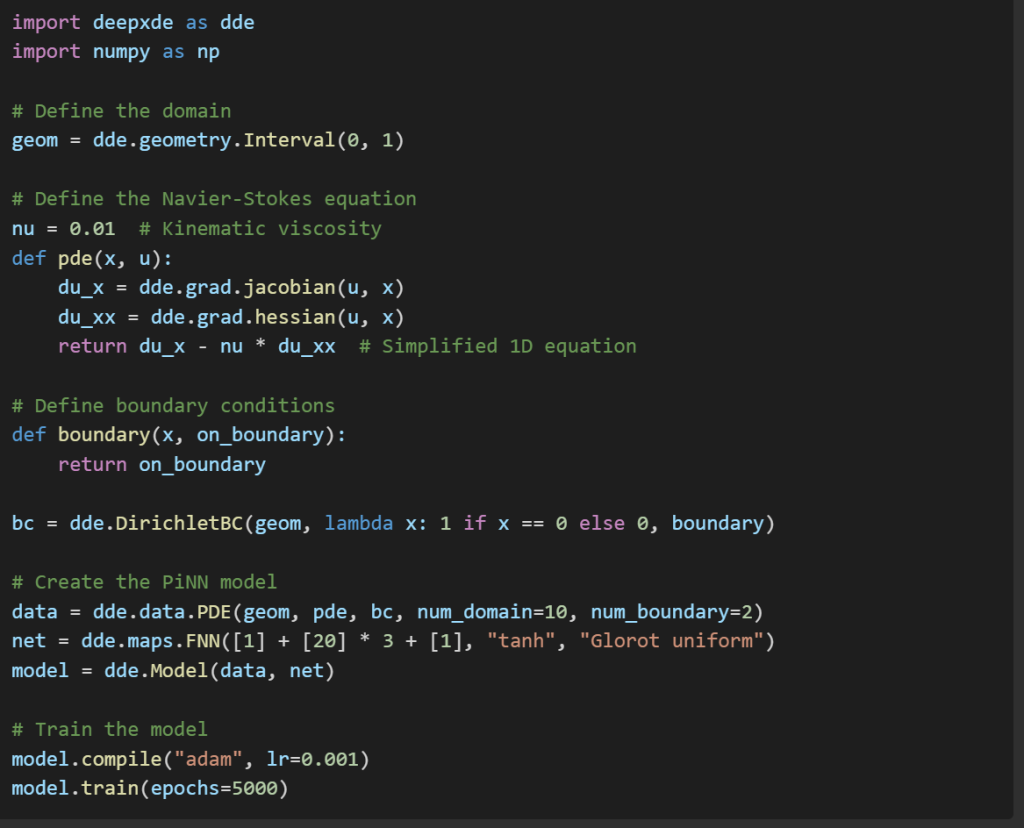
This implementation showcases how PiNNs can be utilized to learn velocity profiles in a simple fluid flow scenario. By incorporating physical constraints within the neural network, PiNNs can effectively model fluid dynamics without relying on large-scale numerical simulations
Challenges in PiNN-Based CFD Analysis
Despite their advantages, PiNNs face several challenges when applied to CFD problems. One significant challenge is the complexity of training deep neural networks for high-dimensional Navier-Stokes equations, which requires careful selection of network architectures and optimization techniques. Hyperparameter sensitivity is another concern, as factors such as network depth, activation functions, and learning rates must be fine-tuned to ensure convergence and stability.
Additionally, handling turbulence remains a major hurdle for PiNNs. While traditional turbulence models rely on established empirical relationships, PiNNs require more advanced architectures and additional constraints to accurately capture turbulent flow behavior. Furthermore, real-world validation of PiNN-based CFD solutions is still in its early stages, and extensive experimental comparisons are needed to establish their reliability across different flow conditions.
Conclusion
Physics-Informed Neural Networks (PiNNs) represent a transformative approach to Computational Fluid Dynamics by integrating physics-based constraints into deep learning models. Their ability to reduce computational costs, handle complex geometries, and operate with sparse data makes them a compelling alternative to traditional CFD solvers. However, challenges such as hyperparameter tuning, turbulence modeling, and real-world validation must be addressed to fully unlock their potential. As research in PiNNs continues to advance, their application in fluid dynamics is expected to grow, paving the way for more efficient and accurate CFD simulations in the future.
