Hello everyone, let me introduce myself. My name is M. Yhandra Adityo, with SID number 2306260151, from the 2023 batch of the Mechanical Engineering major. On this occasion, I would like to talk about the DAI5 framework’s 33 criteria, which must be implemented in every numerical method analysis, such as the heat transfer process that was conducted a few weeks ago, visualized on the video below:
In this presentation, I will show you all 33 DAI5 criteria that have guided me which are:
Chapter 1: Deep Awareness of I
- Consciousness of Purpose: My awareness must be active whenever I perform numerical method analysis, such as in this heat transfer process.
- Self-Awareness: I need to understand who I am, why I am doing this, and how to do it effectively.
- Ethical Consideration: Besides technical knowledge, I must also maintain proper conduct throughout the process.
- Integration of CCIT: CCIT stands for Cara Cepat Ingat Tuhan in Indonesian, meaning “a quick way to remember God.” I must always acknowledge that God is present in my daily life.
- Critical Reflection: I need to reflect on my work to ensure that I perform it as well as possible.
Chapter 2: Intention
- Clarity of Intention: Before starting my work, I must clearly define my intentions.
- Alignment of Objectives: The objectives of my analysis must be well-structured to maximize the quality of my work.
- Relevance of Intention: Besides clarity, my work must always align with my initial objectives.
- Sustainability Focus: I must assess the impact of my work on the environment. Is it beneficial or harmful?
- Focus on Quality: Apart from the quantity of data collected, ensuring high output quality is crucial for achieving the best results.
Chapter 3: Initial Thinking
- Problem Understanding: A clear understanding of the problem allows me to develop an optimal program for generating accurate results.
- Stakeholder Awareness: In this case, the stakeholder refers to the object of my experiment—a stainless steel plate with dimensions of 1×1 meter and a thickness of 0.5 meters.
- Contextual Analysis: My analysis involves various scientific concepts, and I must fully understand them to conduct proper evaluations.
- Root Cause Analysis: I need to determine the fundamental cause of heat transfer and incorporate it into my analysis.
- Relevance of Analysis: Every step in my analysis must be relevant to all surrounding aspects to optimize its benefits.
- Use of Data and Analysis: The more data I collect, the more accurate the results. Therefore, I must gather high-quality data to improve accuracy.
Chapter 4: Idealization
- Assumption Clarity: Assumptions are not always prohibited in technical analysis. Sometimes, they are necessary for running simulations. For example, I assume that my steel plate has uniform thermal conductivity throughout its structure.
- Creativity and Innovation: When encountering unsolvable problems, I must develop creative solutions and alternative methods.
- Physical Realism: My analysis should reflect real-world physical phenomena.
- Alignment with Intention: Every step I take in the analysis must be consistent with my initial objectives.
- Scalability and Adaptability: The results of my program should be applicable to a wide range of fields.
- Simplicity and Elegance: A lengthy process is useless if the output is not useful. The analysis should be as simple as possible while still achieving the intended objectives.
Chapter 5: Instruction Set
- Clarity of Steps: The steps in my analysis must be clear and well-structured so that everyone involved understands their roles.
- Comprehensiveness: My program should be able to analyze a broad range of aspects as effectively as possible.
- Physical Interpretation: I must consider natural physical principles as a guide for analyzing the heat transfer process.
- Error Minimization: A good program should generate numerical outputs that closely approximate real values. To achieve this, I used Python to develop a program that minimizes errors.
- Verification and Validation: My program must be reviewed and validated by experts in the energy conversion sector before being published.
- Iterative Approach: More iterations result in greater precision. In this case, I set my program to run 600 iterations to calculate heat distribution values.
- Sustainability Integration: The results must be widely applicable and beneficial to society in everyday life.
- Communication Effectiveness: To ensure better understanding among those reviewing my results, I must present them clearly and systematically.
- Alignment with the DAI5 Framework: In every technical process I undertake, I must implement deep awareness of I, Intention, Initial Thinking, Idealization, and Instruction Set.
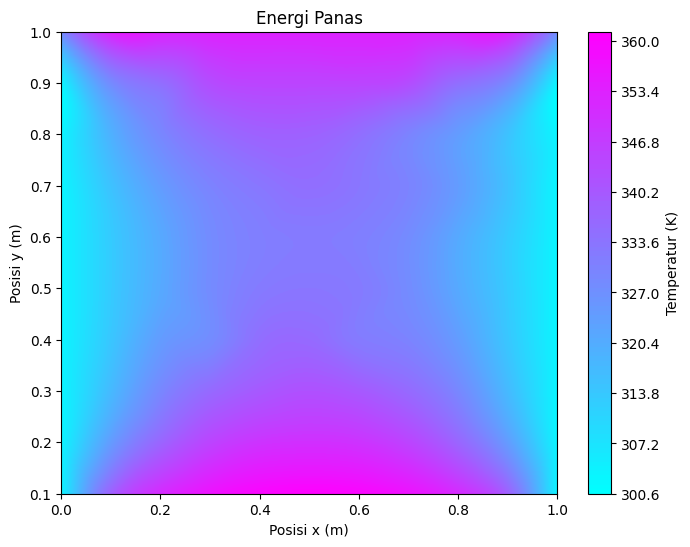
- Documentation Quality: Finally, I have visualized the heat transfer process in a graph, which I will present to you below:
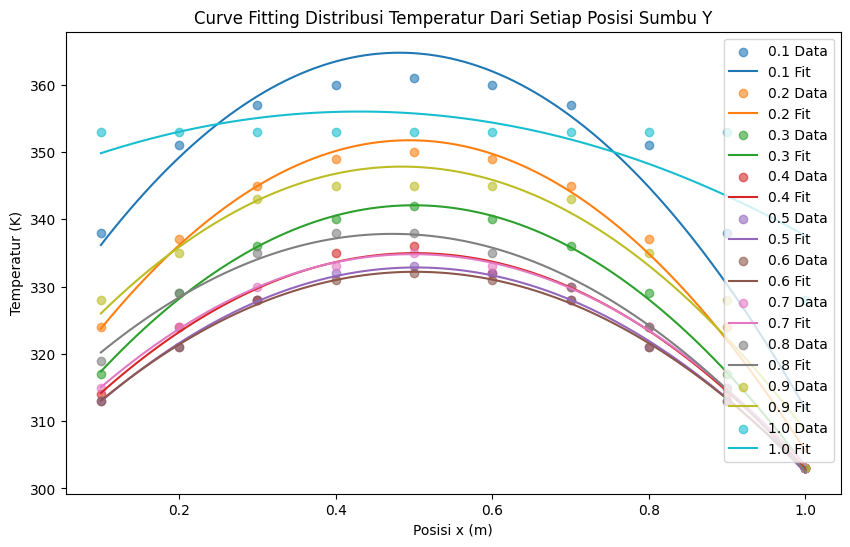
And also, the heat distribution diagram will be shown below: