The lid-driven cavity flow is a fundamental benchmark problem in Computational Fluid Dynamics (CFD). It is widely used for validating numerical solvers and turbulence models due to its simple geometry and well-defined boundary conditions. The problem consists of a square cavity filled with fluid, where the top lid moves horizontally, generating a complex internal flow structure. Researchers have extensively studied this flow case across various Reynolds numbers to validate and compare computational methods. Due to its practical significance, lid-driven cavity flow has applications beyond numerical validation.
This study investigates lid-driven cavity flow for both laminar and turbulent regimes through a combined experimental and numerical approach. The experimental work was conducted in the Cryogenics Lab at the University of New Orleans, using Particle Image Velocimetry (PIV) and Laser Doppler Anemometry (LDA) to capture velocity distributions inside the cavity. These non-intrusive measurement techniques allow for a detailed analysis of the flow field, providing a basis for validating computational models. The numerical simulations were carried out using a commercial CFD solver, implementing the Reynolds-Averaged Navier-Stokes (RANS) equations with a K-Epsilon turbulence model for turbulent cases.
The objectives of this research include validating the accuracy of CFD solvers using experimental data, analyzing the behavior of lid-driven cavity flow under different Reynolds numbers, and studying the influence of lid acceleration on the development of unsteady flow. Additionally, this study aims to improve the accuracy of turbulence models through a calibration process to better match experimental results. By combining experimental data with numerical modeling, this study contributes to a deeper understanding of the lid-driven cavity problem and provides insights into refining CFD simulations for similar internal flow configurations.
Experimental Study
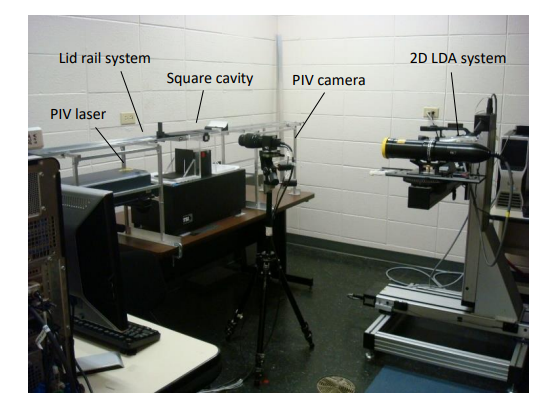
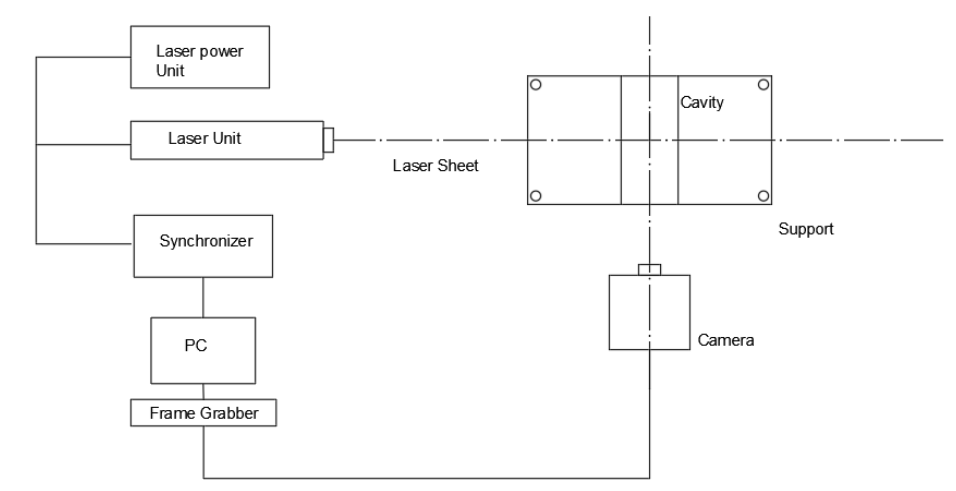

The experimental study measured velocity inside a lid-driven square cavity for both laminar and turbulent flows using non-intrusive techniques. Conducted in the Cryogenics Lab at the University of New Orleans, the setup featured a plexiglass cavity with a moving top lid, while the other walls remained stationary, enforcing a no-slip condition. Deionized water, seeded with silver-coated hollow glass spheres, was used to visualize the flow. Velocity was measured using Particle Image Velocimetry (PIV) for global flow analysis and Laser Doppler Anemometry (LDA) for precise point-based velocity data. PIV employed a dual-cavity Nd:YAG laser and a high-resolution CCD camera, while LDA used an Argon-Ion Laser with fiber-optic probes to capture velocity fluctuations.
To ensure accuracy, PIV measurements were calibrated against LDA data along the vertical centerline. Results showed that PIV and CFD predictions closely matched but overestimated velocity compared to LDA, with discrepancies decreasing at higher Reynolds numbers. Increasing Reynolds numbers led to stronger primary vortices and secondary vortices near the corners due to inertial effects. Higher velocity gradients near the moving lid were confirmed, consistent with boundary layer behavior. The study demonstrated that combining PIV and LDA provided comprehensive velocity measurements, validating the numerical model and emphasizing the importance of turbulence modeling at high Reynolds numbers.
Mathematical Model
The mathematical model describes the motion of an incompressible, viscous fluid inside a two-dimensional, lid-driven square cavity, where the top lid moves with a constant velocity while the other walls remain stationary, enforcing a no-slip boundary condition. The governing equations include the continuity equation, which ensures mass conservation, and the Navier-Stokes equations, which describe the evolution of velocity and pressure due to inertia, viscous forces, and pressure gradients. These equations are solved using the finite volume method (FVM) to discretize the computational domain, allowing numerical approximation of flow behavior.
For laminar flow cases, the incompressible Navier-Stokes equations are used in their standard form, while for turbulent flow cases, the Reynolds-Averaged Navier-Stokes (RANS) equations are applied to account for turbulence effects by averaging velocity fluctuations over time. The K-Epsilon turbulence model is employed to approximate turbulence viscosity, introducing two additional transport equations: one for turbulent kinetic energy (K) and another for turbulent dissipation rate (ε). These equations allow the model to estimate energy production and dissipation due to turbulence, providing a practical balance between computational efficiency and accuracy.
The initial conditions assume that the fluid inside the cavity is at rest, with zero velocity everywhere. The boundary conditions include a constant velocity at the top lid, while the side and bottom walls maintain zero velocity due to the no-slip condition. At high Reynolds numbers, turbulence significantly alters the flow structure, leading to the formation of multiple vortices, which require careful calibration of the turbulence model. The equations are discretized using a second-order upwind scheme for spatial accuracy, and a pressure-based solver is used for incompressible flow calculations. The numerical model provides a theoretical basis for simulating flow structures and is later validated against experimental results.
Validation and Verification of the Numerical Method
To ensure the reliability of the numerical simulations, a series of validation and verification steps were performed. The mesh independence study was conducted by refining the grid resolution in both 2D and 3D simulations, ensuring that the computed results were not significantly affected by grid density. A finer mesh resulted in a more accurate flow field representation, but computational cost was also considered. The time independence study was carried out for unsteady flow cases, testing different time step sizes to verify that the solution remained stable and did not introduce numerical artifacts.
The solver settings were carefully selected to balance computational efficiency and accuracy. A pressure-based solver was used, as it is well-suited for incompressible flow, with second-order upwind discretization applied to improve spatial accuracy. The coupled algorithm was chosen for pressure-velocity coupling, ensuring faster convergence and better stability compared to segregated approaches. The numerical solution was validated against benchmark data, including results from Ghia et al.., a well-known reference for lid-driven cavity flow studies. Velocity profiles along the vertical and horizontal centerlines were compared, showing good agreement with benchmark values, particularly at lower Reynolds numbers.
Further validation was conducted by comparing numerical predictions with experimental data obtained from PIV and LDA measurements. The results showed that while the CFD model captured the primary vortex structures accurately, minor deviations occurred near the walls due to turbulence modeling limitations. At higher Reynolds numbers, discrepancies between simulated and measured velocity magnitudes became more pronounced, highlighting the need for improved turbulence model calibration. Despite these differences, the overall agreement between numerical and experimental results confirmed that the solver provided a reliable representation of lid-driven cavity flow dynamics.
Numerical Simulations Result
The numerical simulations were performed for both laminar and turbulent flow cases, analyzing the velocity distribution, vortex formation, and pressure variations within the lid-driven cavity. For low Reynolds numbers (Re < 2000), the results showed the formation of a single primary vortex in the center of the cavity, with smooth, well-defined streamlines. The flow remained steady, and viscous forces dominated inertial effects, leading to a gradual decay of velocity gradients near the walls. As the Reynolds number increased, the primary vortex became more pronounced, and secondary vortices began to emerge near the bottom corners of the cavity due to increased flow recirculation.
For higher Reynolds numbers (Re > 5000), the flow transitioned to a turbulent regime, requiring the use of Reynolds-Averaged Navier-Stokes (RANS) equations with a K-Epsilon turbulence model. The simulations captured multiple vortex structures, including secondary and tertiary vortices near the cavity corners, which intensified as Reynolds numbers increased. The results showed a significant velocity gradient near the moving lid, consistent with experimental observations. However, at high Reynolds numbers, the standard K-Epsilon model overpredicted velocity magnitudes, especially near the core of the primary vortex, due to its limitations in accurately representing turbulent dissipation.
Comparisons between CFD and experimental data demonstrated good agreement in velocity profiles along the horizontal and vertical centerlines, with minor discrepancies near the cavity walls. The numerical results closely matched PIV and LDA measurements for laminar cases, while deviations in turbulent cases were attributed to turbulence modeling approximations. Overall, the simulations successfully reproduced the key flow characteristics of lid-driven cavity flow, validating the computational approach and highlighting the importance of turbulence model selection for high-Reynolds-number flows.
Unsteady Flow Analysis
The study also investigated the transient behavior of lid-driven cavity flow, analyzing how vortices developed and evolved over time when the lid motion was not instantaneous. In unsteady cases, the acceleration profile of the lid significantly influenced the flow evolution, affecting the formation and stabilization of vortices. Simulations were conducted for different lid acceleration profiles, including step, linear, and sinusoidal accelerations, to examine their impact on circulation patterns.
For sudden (step) acceleration, the flow rapidly developed a primary vortex, with strong velocity gradients near the lid. However, due to the abrupt nature of the motion, small-scale secondary vortices formed near the corners early in the transient phase before reaching a steady state. In contrast, linear acceleration resulted in a gradual buildup of the primary vortex, with delayed but more stable vortex formation. The sinusoidal acceleration profile led to periodic variations in vortex size and intensity, causing oscillations in the velocity field and a slower stabilization process.
The simulations also tracked vortex displacement and kinetic energy evolution over time, showing that higher Reynolds numbers led to a longer flow stabilization period. The energy dissipation rate was higher in turbulent cases, where small-scale eddies contributed to unsteady flow behavior. Flow structures exhibited asymmetry during the transient phase, particularly at higher Reynolds numbers, before eventually settling into a quasi-steady state.
These findings demonstrated that unsteady effects play a crucial role in lid-driven cavity flow dynamics, particularly in practical applications where boundary motion is not instantaneous. The study provided insights into how initial acceleration conditions influence vortex formation, emphasizing the need for transient analysis when modeling real-world shear-driven flows.
Conclusion and Recommendations
The study successfully analyzed lid-driven cavity flow using both experimental and numerical approaches, providing insights into flow behavior across different Reynolds numbers. The numerical simulations, validated against experimental data and benchmark studies, demonstrated the effectiveness of CFD modeling in capturing key flow characteristics. For laminar cases, the simulations accurately predicted single primary vortex formation, while for higher Reynolds numbers, secondary and tertiary vortices were observed, consistent with experimental measurements. The K-Epsilon turbulence model, while effective for general predictions, exhibited limitations in capturing near-wall velocity gradients and turbulence dissipation, leading to overprediction of velocity magnitudes in turbulent cases.
The experimental study, using PIV and LDA, provided precise velocity measurements, revealing key differences between numerical and physical results, particularly near the cavity walls. Mesh and time independence studies confirmed the numerical model’s robustness, with finer grid resolutions improving accuracy. However, turbulence modeling discrepancies highlighted the need for further calibration or advanced models such as Large Eddy Simulation (LES) or Direct Numerical Simulation (DNS) for better high-Reynolds-number predictions.
For future work, the study suggests improving turbulence modeling techniques and exploring alternative closure models to enhance accuracy in shear-driven cavity flows. Extending the analysis to three-dimensional cavity flows would capture spanwise effects not present in 2D models. Additionally, further experimental validation, possibly incorporating higher-speed imaging and refined seeding particle techniques, could enhance measurement precision and reduce uncertainties. These recommendations provide a pathway for refining numerical and experimental approaches to better understand complex flow dynamics in cavity-driven flows.
