
A. Project Title
AI-Assistant to optimized material selection, energy and cost in building
B. Author Complete Name
Rizky Nugraha – 2506669320
C. Affiliation
Department of Mechanical Engineering, Faculty of Engineering, Universitas Indonesia
D. Abstract
This report discusses the conceptual design of a Building AI Assistant as a decision support system aimed at improving operational efficiency, user comfort, and integration in modern building management. The approach used focuses on the integration of sensor data, building management systems, and artificial intelligence-based interactions to bridge the complexity of building systems with human needs in a contextual manner.
System development begins with an idealization process to formulate a vision of a smart building in ideal conditions, then translated through computational thinking so that complexity can be systematically described. The instruction set is structured as a logical workflow that explains how the system understands context, classifies user intent, processes data, and generates explainable responses or recommendations. The discussion demonstrates that the primary value of the AI Assistant Building lies in its clear decision-making process and modular approach, allowing for gradual, human-centered development.
This report also examines system limitations, particularly related to data quality, dynamic scenario complexity, and organizational adoption factors. Overall, the AI Building Assistant is positioned as an enabler system that strengthens the role of humans in decision-making, not as a complete replacement. The report’s primary contribution is the development of a structured conceptual framework that can serve as a basis for further development and research related to AI systems in the built environment.
E. Author Declaration
1. Deep Awareness (of) I
In this rather diverse and chaotic world, we as human beings often lost our direction in life. Through time, rules and morals can change depends on society and time, that there is no right or wrong answer. Guided by this reason, the writer seek to find reason in life, that through higher entity. The only one who has the last say when it comes to finding solution in this life and hereafter. Within this very reason, the writer realize there is ethical awareness contributing positively without becoming burden to others.
We, As a human being, always strive for better. Whether that is better results, income, or job, we will learn and try harder to achieve it. But sometimes we often forgot the very reason of why we chase those things. Learning is just understanding how things work, but also applying problem-solving in daily practice and continuously reflecting on how to improve. This project serve as a learning tool to develop writer cognitive capability through repetitive practice and reflection.
2. Intention of the Project Activity
This project develops predictive models in finding optimum specification for a building or how to increase optimization in buildings through MCDM method that will be applied within coding procedures. The entire aspect, from model development, script refinement, and AI-assistant automation, are approached under computational thinking framework, ensuring systematic problem-solving, flexibility, and real-world practical applicability.
This project aim is not only final material and output cost, but rather helping user to understand step-by-step and consideration points on how to optimized buildings creatively. By integrating AI-assisted workflows, the project simplify the chores of many methods, and minimizing the need for continuous human intervention.
F. Introduction
Energy and material are major contributors to building, giving us a place under roof and comfort while providing a sense of safety. This report explains the concept, architecture, and working principle of the AI Building Assistant—an intelligent assistant system designed to assist in the management, operation, and user experience of buildings (e.g., office buildings, campuses, hospitals, or shopping malls). This system combines artificial intelligence, IoT sensors, and a human interaction interface to answer questions, make recommendations, and perform automated actions based on real-time data.
The primary goal of the AI Building Assistant is to improve operational efficiency, occupant comfort, and data-driven decision-making. This system is not simply a chatbot, but rather a decision-support system capable of understanding the building’s context and user dynamics.
Initial Thinking (about the Problem):
Systematic Problem Breakdown
The problem to be solved can be systematically broken down as follows:
- Complexity of Building Information
Building data is scattered across multiple sources: floor plans, room schedules, environmental sensors, security systems, and utility systems. Without integration, this information is difficult to utilize effectively.
2. Inefficient User Interaction
Users often struggle to find simple information such as room location, facility status, or emergency procedures.
3. Manual and Reactive Operations
Many operational decisions (AC, lighting, security) are still based on static schedules or late reactions to problems.
4. Lack of Context and Predictability
Conventional systems rarely utilize historical patterns to predict needs or potential disruptions.
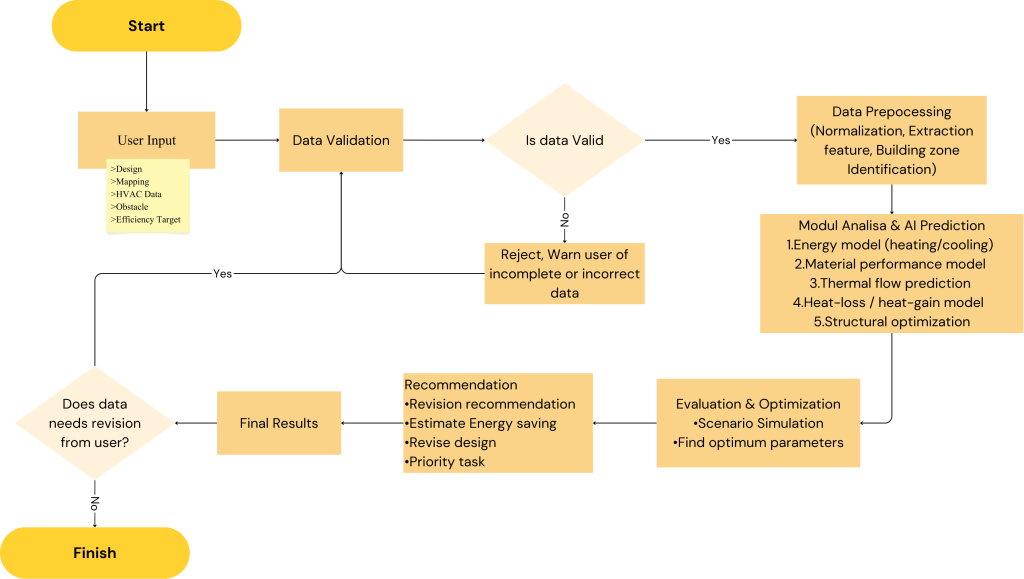
From this breakdown, the system’s core requirements can be formulated: data integration, context understanding, the ability to interact naturally, and decision-making support.
G. Methods & Procedures
Methods and Procedures
The methods used in developing the AI Building Assistant include several main layers:
- Data Acquisition
Data is obtained from:
- IoT sensors (temperature, humidity, occupancy, air quality)
- Building management system (BMS)
- Static database (floor plan, room list, SOP)
- User input (text or voice)
2. Data Processing and Integration
Data is aligned in a single data layer using an ETL (Extract, Transform, Load) pipeline for consistent analysis.
3. AI Modeling
- Natural Language Processing (NLP) to understand user queries
- Rule-based logic for standard procedures (e.g., emergencies)
- Simple predictive models for space and energy usage patterns
4. Response and Action
- The system generates responses in the form of:
- Informative answers
- Recommended actions
- Trigger automated actions to building systems (if permitted).
Idealization:
In the idealization stage, the AI Building Assistant is seen as an ideal entity that has a comprehensive understanding of building conditions without being bound by the limitations of the initial implementation. The building is assumed to have been digitally represented (digital twin) so that every space, facility, and human flow can be understood as a clear object and relationship. Under these ideal conditions, sensor data is considered consistent, real-time, and reliable, while user interactions occur naturally without technical barriers. Idealization serves as a conceptual compass: not to describe the current real conditions, but rather as a reference for the direction of system development so that every design decision remains aligned with the long-term goal of an adaptive, informative, and human-centered building.
Computational Thinking
A computational thinking approach is used to translate the complexity of a building into a form that can be systematically processed by machines. Large, interconnected building problems are decomposed into functional modules such as navigation, energy management, security, and user services. From these modules, behavioral patterns begin to be identified, for example daily occupancy patterns, peak hours of facility use, or environmental anomaly tendencies. The physical complexity of the building is then abstracted into logical representations in the form of digital entities and relationship rules, allowing the system to operate at the conceptual level, rather than solely on physical details. The entire process is bound by a clear algorithmic logic, where system decisions follow a cause-and-effect path that can be explained, audited, and incrementally improved.
Instruction (Set):
The AI Assistant Building instruction set is designed as a series of logical, interconnected steps, rather than a rigid list of commands. The system begins by receiving input from both the user and the building’s sensors, then places that input in the appropriate context based on the user’s location, time of day, and role. Once the context is understood, the system classifies the intent of the interaction—whether the user needs information, navigation, recommendations, or direct action. Relevant data is then captured and processed using appropriate rules or models, before the system generates the most sensible response or action. The entire process concludes with the interaction being recorded as feedback, allowing the system to be evaluated and refined. The instruction set is modular and evolving, allowing for the addition of new intelligence as the building’s complexity and needs increase.
H. Results & Discussion
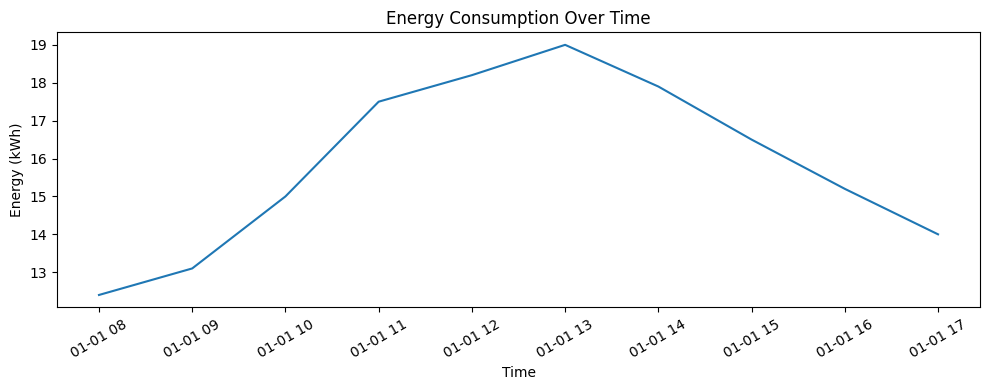
The conceptual design of the AI Assistant Building demonstrates that the system is capable of integrating various building functions into a coherent interaction framework. Based on the previously discussed flowchart, the system can logically handle simple information requests, navigation support, and operational recommendations based on environmental and occupancy conditions. This flow demonstrates how every system decision is preceded by an understanding of context, ensuring that the resulting response is not generic but relevant to the user’s situation and the current building conditions.
The key discussion from these results emphasizes that the value of the AI Building Assistant lies not in the sophistication of its algorithm alone, but rather in its ability to bridge humans with complex building systems. With a clear and documented decision flow, the system becomes explainable and more easily accepted by users and building managers. This is important because unexplainable systems tend to generate resistance, especially when they begin to interact with critical aspects like safety or comfort.
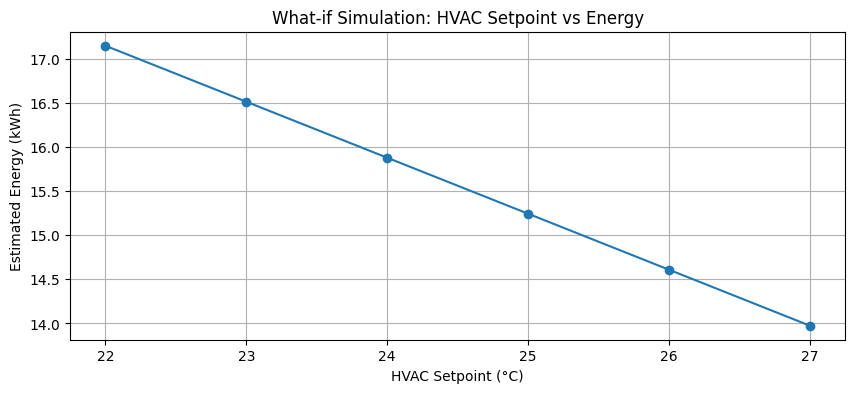
Furthermore, the modular approach used allows the system to evolve incrementally. Initial implementation can focus on low-risk functions such as providing information and recommendations, before progressing to more complex automated actions. This discussion demonstrates that the AI Building Assistant acts as an enabler system, strengthening human capabilities rather than replacing them. This approach aligns with the principles of socio-technical system design, which maintains human decision-making.
Limitations
Despite its systematic design, the AI Assistant for Buildings has several limitations that require critical consideration. The system is highly dependent on the quality and availability of sensor data; Incomplete, unsynchronized, or biased data can directly degrade the quality of analysis and recommendations. In the context of older buildings or buildings with limited infrastructure, this can be a major implementation barrier.
Furthermore, early AI models tended to be deterministic or simply predictive. While this approach improved system reliability and explainability, it limited the system’s ability to handle highly dynamic or unpredictable scenarios. Another limitation arose in user and organizational adoption, where trust in the system, human resource readiness, and internal policies often played a greater role in determining implementation success than purely technical factors.
I. Conclusion, Closing Remarks, Recommendations
Based on the overall discussion, it can be concluded that the AI Building Assistant is a viable and relevant approach to addressing the challenges of modern building management. By combining idealization, computational thinking, and a structured instruction set, this system is able to simplify building complexity into meaningful and functional interactions.
The main conclusion of this conceptual study is that AI is most effective when positioned as an adaptive and contextual decision-making tool. The Building AI Assistant is not designed as a fully autonomous system that replaces humans, but rather as a digital partner that improves decision quality, operational efficiency, and the overall user experience.
Closing Remarks
The development of the AI Building Assistant reflects a paradigm shift from passive buildings to responsive and contextual ones. This system is not just about technology, but also about how humans interact with built spaces in a more intelligent and meaningful way.
In a broader context, the AI Building Assistant can be seen as the first step toward an integrated smart built environment ecosystem. The success of this system will be largely determined by the balance between technical innovation, human-centered design, and responsible governance.
Recommendations
For further development, it is recommended that the system be tested through real case studies on a specific building type before being expanded to a more complex scale. This approach allows for a more measurable, incremental evaluation of system performance, user acceptance, and operational impact.
Furthermore, the integration of long-term historical data and the enhancement of predictive models are recommended to improve the quality of recommendations. From a non-technical perspective, user education strategies, data governance policies, and clear boundaries of responsibility between humans and systems are needed to ensure the sustainable and ethical implementation of AI Building Assistants.
Key Contributions
The main contribution of this AI Building Assistant design lies in the development of a clear and structured conceptual framework, from idealization to operational instruction set. This framework demonstrates how the complexity of building systems can be systematically addressed without sacrificing logical clarity and human roles.
Furthermore, this discussion provides a methodological contribution by emphasizing the importance of a modular approach, explainable decision flows, and human-centered design in developing AI systems for the built environment. This contribution can serve as a foundation for further research and the practical implementation of AI Building Assistants in various contexts and scales.
J. Acknowledgments
I would like to thank my colleagues and my professors who always spirited me during this difficult process. And i would like to thank all members of mechanics fluids lab to allow me to learn with them. And i would like to thank Prof Indra for allowing writer to use AIDAI5 to have a deeper learning about coding and artificial intelligence. Also, the writer would like to thank Universitas Indonesia for providing the writer a place to learn.
K. (References) Literature Cited
ASHRAE. (2017). ASHRAE handbook: Fundamentals. American Society of Heating, Refrigerating and Air-Conditioning Engineers.
ASHRAE. (2019). ASHRAE handbook: HVAC applications. American Society of Heating, Refrigerating and Air-Conditioning Engineers.
Blanchard, B. S., & Fabrycky, W. J. (2011). Systems engineering and analysis (5th ed.). Pearson Education.
Deb, K. (2012). Optimization for engineering design: Algorithms and examples (2nd ed.). PHI Learning.
Hyndman, R. J., & Athanasopoulos, G. (2021). Forecasting: Principles and practice (3rd ed.). OTexts.
Incropera, F. P., DeWitt, D. P., Bergman, T. L., & Lavine, A. S. (2011). Fundamentals of heat and mass transfer (7th ed.). John Wiley & Sons.
Kluyver, T., Ragan-Kelley, B., Pérez, F., Granger, B., Bussonnier, M., Frederic, J., … Willing, C. (2016). Jupyter notebooks—A publishing format for reproducible computational workflows. In Positioning and Power in Academic Publishing: Players, Agents and Agendas (pp. 87–90). IOS Press.
Russell, S. J., & Norvig, P. (2021). Artificial intelligence: A modern approach (4th ed.). Pearson.
Turban, E., Sharda, R., & Delen, D. (2017). Decision support and business intelligence systems (10th ed.). Pearson Education.
Winston, W. L. (2004). Operations research: Applications and algorithms (4th ed.). Duxbury Press.
L. Appendices
Link to Youtube:
Link to Gdrive: https://drive.google.com/drive/folders/1zOrEaEbQAOSTYNxpzz_hjJ2GGJ3sWX9c
| index | timestamp | temperature | energy_use | occupancy | recommendation |
|---|---|---|---|---|---|
| 0 | 2025-01-01 08:00:00 | 26.5 | 12.4 | 30 | Setpoint AC sudah optimal |
| 1 | 2025-01-01 09:00:00 | 27.2 | 13.1 | 45 | Setpoint AC sudah optimal |
| 2 | 2025-01-01 10:00:00 | 28.1 | 15.0 | 60 | Setpoint AC sudah optimal |
| 3 | 2025-01-01 11:00:00 | 29.0 | 17.5 | 70 | Setpoint AC sudah optimal |
| 4 | 2025-01-01 12:00:00 | 30.2 | 18.2 | 80 | Turunkan setpoint AC (ruangan terlalu panas) |
| 5 | 2025-01-01 13:00:00 | 31.0 | 19.0 | 85 | Turunkan setpoint AC (ruangan terlalu panas) |
| 6 | 2025-01-01 14:00:00 | 30.5 | 17.9 | 75 | Turunkan setpoint AC (ruangan terlalu panas) |
| 7 | 2025-01-01 15:00:00 | 29.5 | 16.5 | 60 | Turunkan setpoint AC (ruangan terlalu panas) |
| 8 | 2025-01-01 16:00:00 | 28.6 | 15.2 | 50 | Setpoint AC sudah optimal |
| 9 | 2025-01-01 17:00:00 | 27.8 | 14.0 | 40 | Setpoint AC sudah optimal |
| index | timestamp | temperature | recommendation |
|---|---|---|---|
| 0 | 2025-01-01 08:00:00 | 26.5 | Setpoint AC sudah optimal |
| 1 | 2025-01-01 09:00:00 | 27.2 | Setpoint AC sudah optimal |
| 2 | 2025-01-01 10:00:00 | 28.1 | Setpoint AC sudah optimal |
| 3 | 2025-01-01 11:00:00 | 29.0 | Setpoint AC sudah optimal |
| 4 | 2025-01-01 12:00:00 | 30.2 | Turunkan setpoint AC (ruangan terlalu panas) |
| 5 | 2025-01-01 13:00:00 | 31.0 | Turunkan setpoint AC (ruangan terlalu panas) |
| 6 | 2025-01-01 14:00:00 | 30.5 | Turunkan setpoint AC (ruangan terlalu panas) |
| 7 | 2025-01-01 15:00:00 | 29.5 | Turunkan setpoint AC (ruangan terlalu panas) |
| 8 | 2025-01-01 16:00:00 | 28.6 | Setpoint AC sudah optimal |
| 9 | 2025-01-01 17:00:00 | 27.8 | Setpoint AC sudah optimal |
